

You book a double room in a hotel in Germany or Austria, picturing the one wide, continuous mattress you would get back home, and you open the door to something that quietly gives you pause. The bed is more or less the right width, but run your hand across the surface and you find a seam straight down the middle, a ridge or a gap where two separate mattresses meet, and often two separate duvets laid neatly side by side instead of one big one that covers the whole bed. What you booked as a double is really two twin mattresses pushed together, and the crevice between them is waiting to swallow an elbow, a knee, or an entire sleeping partner who happens to drift too close to the center in the night. Every American who has traveled in Central Europe has met this bed and wondered what on earth is going on, usually at the worst possible moment, jet-lagged and longing to fall into a proper bed only to find a seam waiting to divide them from their partner. Here is the mystery of the pushed-together double, the gap down its middle, and the surprisingly sensible system behind it. Like a lot of things that baffle travelers, it turns out to be neither a mistake nor laziness but a genuinely different way of solving a problem everyone has, which is how two people are supposed to share a single bed and still both sleep well.
What follows is the gap itself, the two different versions of this bed you might actually meet, why Europe builds its beds this way, the terminology trap that lands you in one, and what to do when you find yourself facing the crevice.
The Gap in the Middle

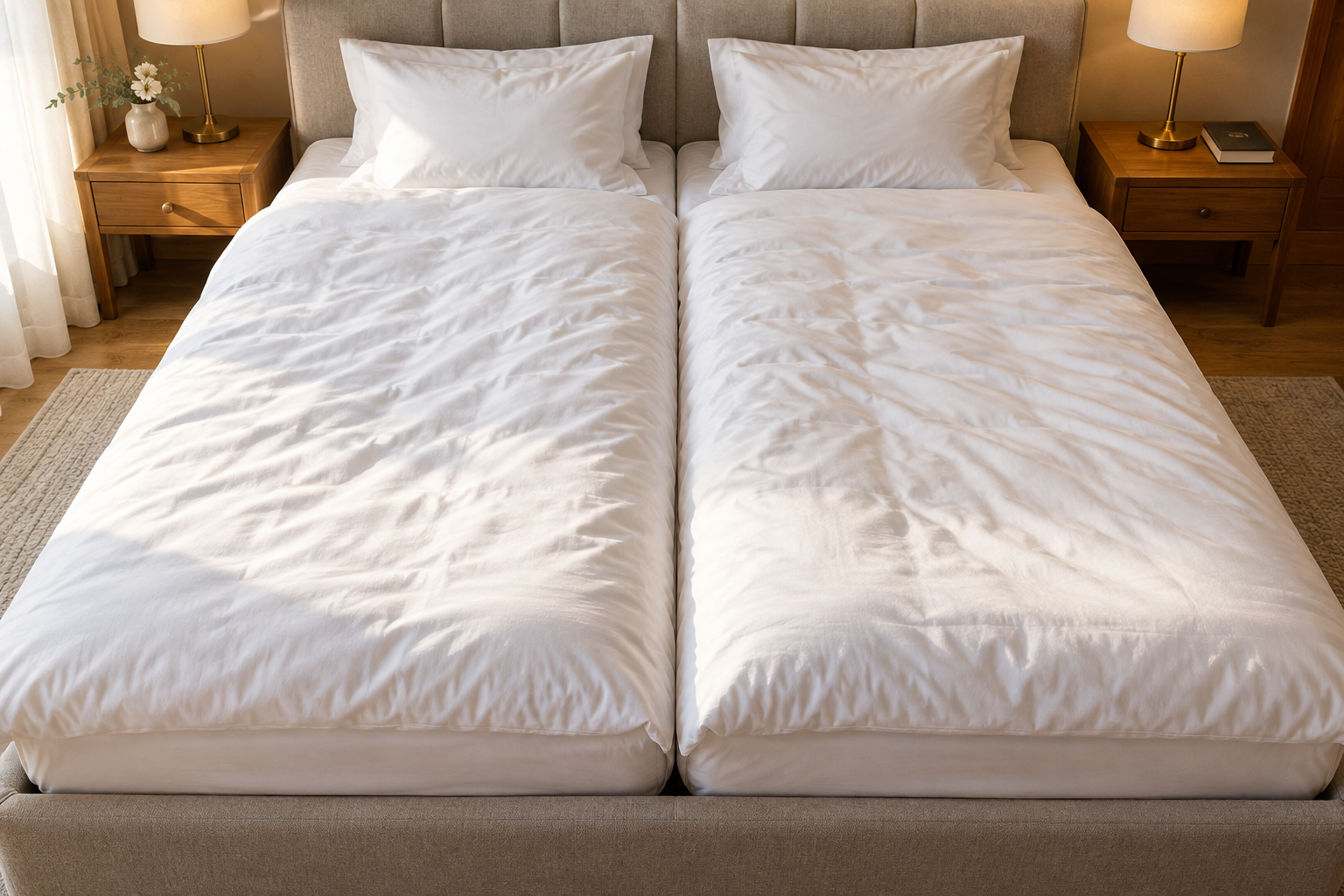
The defining feature, and the one that most unsettles the first-time visitor, is that seam running down the center of the bed. Because the double is made of two separate single mattresses set side by side, there is inevitably a line where they meet, and depending on how the bed is made up that line can be anything from a barely-there crease to a genuine gap you can feel and even see. Some hotels lay a single large fitted sheet over both mattresses to smooth it over; others put a separate sheet on each, which makes the dividing line even more pronounced. A single sheet stretched tight can hide the seam surprisingly well until you lie down and feel it; two sheets give up the game before you have even sat on the bed.
The Germans have a word for this crevice: the Besucherritze, which translates roughly as the visitor’s gap, with the joking implication that a third person could sleep down there in the middle. That name captures the traveler’s experience exactly, because the gap has a way of asserting itself the moment you stop thinking about it, and a couple hoping to share a bed can find themselves rolling apart into their separate mattresses with a small no-man’s-land between them. For the American expecting a single continuous surface, this is the disconcerting heart of the mystery, the discovery that the double bed is not really one bed at all but two, honestly if slightly awkwardly joined, with a seam that no amount of wishful thinking makes disappear. The first night with it is often a small comedy of readjustment, one partner or the other repeatedly drifting into the trench in the middle and hauling back out of it, until you learn to claim a side and stay on it.
The Two Versions You Might Meet

Not all of these beds are the same, though, and it helps to know that there are really two versions, one intentional and one improvised. The proper, intentional version, and the true Central European standard, is a single large bed frame, often around two meters wide, into which two single mattresses are set side by side. This is not two beds shoved together but one bed built to hold two mattresses, a deliberate design, and it is simply how a great many German and Austrian couples have their beds at home. The frame is one piece; the mattresses within it are two. Made this way and made up well, it can be almost seamless, the two mattresses snug against each other under a single sheet, and a visitor might sleep on it for a week without ever quite registering that the bed underneath them is technically a pair.
The improvised version is the one that ambushes travelers, and it is more of a hotel workaround than a design. When a hotel runs short of proper double rooms to meet demand, it will often take a twin room and simply push the beds together to make a double, sometimes clipping the frames so they cannot drift apart in the night. This version tends to have the more pronounced gap and the greater tendency to separate, because it really is two independent beds pretending to be one. If the frames are not clipped, a restless night can slowly work them apart, so that you wake to find the gap has widened into a genuine gulf and one bed has wandered off toward the wall. Both versions share the other feature that puzzles Americans, which is the bedding: rather than one large duvet spanning the whole bed, each sleeper typically gets their own single-sized duvet, two separate covers side by side, and often no top sheet in the American sense at all. So the pushed-together mattresses come with pushed-together bedding, two of everything, which doubles the sense that you are looking at two beds wearing the costume of one.
Why Europe Builds Beds This Way

Before writing the whole thing off as a failure of hotel logistics, it is worth understanding the genuine logic behind the two-mattress bed, because in its intentional form it solves several problems rather neatly. The first is firmness. Two separate mattresses mean two people who disagree about firmness can each have exactly the mattress they want in the same bed, a soft one and a firm one side by side, which a single shared mattress can never do. It is, in effect, a low-tech version of the adjustable beds sold at great expense elsewhere, achieved simply by using two mattresses instead of one. One partner can sleep on something firm and orthopedic while the other sinks into something soft, and neither has to lie awake resenting the other’s choice, which is more than most expensive shared mattresses can honestly promise.
The two-duvet system solves a parallel set of problems, and it is quietly brilliant once you get used to it. With separate duvets, no one steals the covers in the night, no one is dragged awake when the other turns over, and two people who run at different temperatures can each have the weight of duvet that suits them. The couple gets to be together when they want and undisturbed when they do not, each in their own cocoon, which many people who try it come to strongly prefer. It is a small revelation for anyone who has spent years in a low-grade nightly tug of war over a shared duvet to discover that the whole conflict was optional all along.
And underneath both features runs a practical hotel logic: a bed built as two singles is endlessly flexible, since the same room can be sold as a double to a couple or, separated, as a twin room to two friends or colleagues who have no wish to share a bed. Two singles that can be a double or a twin are simply more useful to a hotel than a fixed double, and more hygienic to service, with separate linens for each side. A single flexible room type that can suit a couple one night and two colleagues the next is worth a great deal to a hotel, and much of what puzzles the guest is really the visible trace of that flexibility. What looks at first like a compromise is, in its proper form, a system with several real advantages, most of which the frustrated tourist never stops to notice. The visitor sees only the gap and the two duvets and reads them as a hotel cutting corners, when in fact they are the visible signs of a considered approach to sleep that the locals chose on purpose and would not trade for the American single mattress.
Togetherness Without Merger

Step back from the mattresses and the duvets and there is something quietly interesting in what this bed says about how a culture thinks two people should sleep together. The American default, one big shared mattress under one shared blanket, treats sleeping together as a kind of merger, two people becoming one undifferentiated sleeping unit, and it quietly asks them to compromise on firmness, temperature, and covers for the sake of that union. The continental bed makes a different bargain: you share the bed and the room and the night, but you keep your own mattress, your own duvet, your own warmth and your own space, together and separate at the same time.
There is a good deal to be said for that arrangement, and the wider world has slowly been coming around to it. The rise of what gets called the sleep divorce, couples choosing separate duvets or even separate beds to sleep better, is really just the rest of the world discovering what the two-mattress bed has quietly offered all along, that sharing your life with someone need not mean sharing their exact preference in mattress firmness or their tendency to steal the blankets at three in the morning. Seen in that light, the pushed-together double is not a failure to make a proper shared bed but a rather mature answer to the real problem of two different bodies trying to sleep well in the same place. It lets a couple be close without being fused, which many people, once they stop expecting the American single surface, find is exactly what they wanted from a shared bed anyway.
The Terminology Trap
A good part of the frustration, though, comes not from the bed itself but from the word attached to it, because the term double bed does not mean the same thing in Europe as it does in America, and that mismatch is what lands travelers in an unexpected bed. In the United States, a double is a familiar, specific thing, a single continuous mattress of a known size. In much of Europe, and especially in the German-speaking countries, booking a room described as a double can get you exactly the two-mattresses arrangement, because that is what a double often is there, and the English word on the booking site does not warn you.
This is where real disappointment can creep in, because the two arrangements are genuinely different to sleep on, and a couple booking what they think is a proper double bed for a romantic trip can arrive to find the seamed, gapped, two-duvet version instead. Worse, in some cases what is sold as a double is on the smaller side by American standards, travelers can end up with both surprises at once, a bed that is both split and smaller than expected. The word, in other words, is doing less work than the traveler assumes, and treating a European double booking as if it guaranteed an American double bed is the single most common way people end up baffled at the sight of that central seam. The booking said double; the bed is telling a more complicated story. Learning to hear that story before you arrive, rather than at the foot of the bed at midnight, is most of what it takes to never be caught out by it again.
What to Do When You Find the Crevice
The practical fixes for all this are simple once you know the bed exists, and they start before you ever arrive. Because the terminology is unreliable, the surest move is to contact the hotel directly after booking to ask what their double actually is, whether it is one mattress or two, and to state plainly what you actually want, either a genuine single double surface or, alternatively, a proper twin room with the beds set apart. Hotels deal with this question constantly and are generally happy to sort it out, and a quick message ahead of time heads off the surprise at check-in entirely. It is a far better use of five minutes than arriving tired after a long journey to discover that your romantic double is a pair of singles with a canyon down the center.
If you do end up facing the crevice, there are ways to tame it, and none of them requires suffering through the night as it is. Hotels that know their beds split often have a fix on hand, either a large mattress topper laid over both to smooth the whole surface into one, or a foam wedge, sometimes called a love bridge, that fills the gap in the middle so you cannot roll into it. It is entirely reasonable to ask for one. And there is a case for simply embracing the system rather than fighting it, since the two-duvet arrangement in particular wins over a surprising number of the travelers who arrive skeptical, once they discover a night without a cover-stealing partner. But if a single unbroken bed genuinely matters to your trip, do not trust the word double to deliver it: ask first, confirm what you are getting, and you will never again open a hotel door to that puzzling seam down the middle. The gap is only a mystery until you know to check for it, and once you do, it joins the small collection of things a seasoned traveler simply handles rather than being ambushed by, one more quiet difference between how two places do an ordinary thing.

About the Author: Ruben, co-founder of Gamintraveler.com since 2014, is a seasoned traveler from Spain who has explored over 100 countries since 2009. Known for his extensive travel adventures across South America, Europe, the US, Australia, New Zealand, Asia, and Africa, Ruben combines his passion for adventurous yet sustainable living with his love for cycling, highlighted by his remarkable 5-month bicycle journey from Spain to Norway. He currently resides in Spain, where he continues sharing his travel experiences with his partner, Rachel, and their son, Han.