
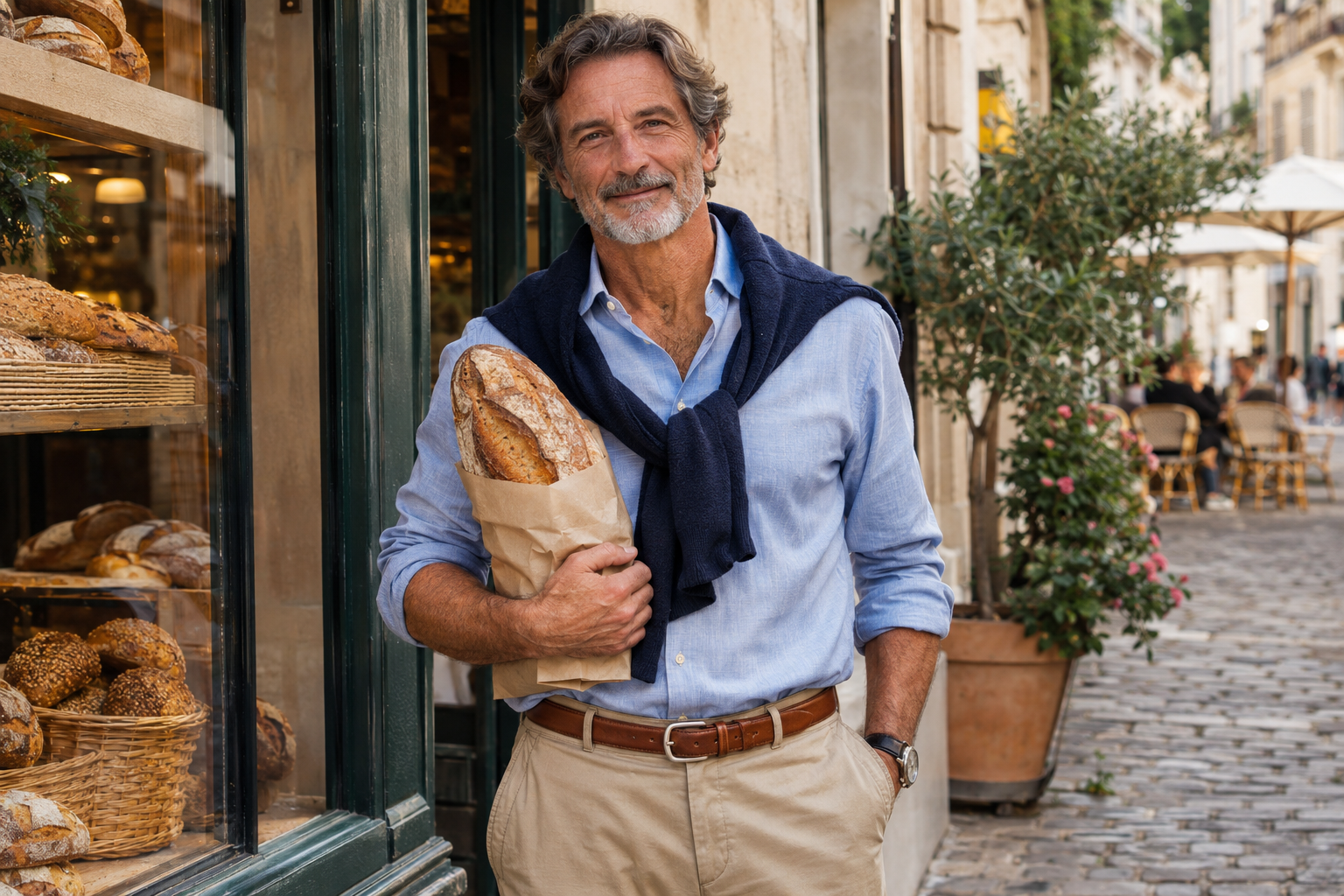
Watch a European man step out to the bakery for a loaf of bread on an ordinary morning. Nothing special is happening, it is the most mundane errand there is, and yet he is wearing a shirt tucked neatly into his trousers, with a leather belt at his waist. Even for bread. Even for five minutes on the street.
Now watch the American man run the same errand. He is in an untucked t-shirt or a loose, hanging button-down, probably shorts, almost certainly no belt, comfortable and casual and entirely relaxed. And the difference between those two men, tucked and belted versus untucked and loose, is one of the single most reliable ways to tell an American from a local on a European street, before either of them has said a word.
It seems almost too small to matter, a tucked shirt and a belt. But it is one of those tiny details that quietly separates the put-together local from the obvious tourist, and the remarkable thing is that fixing it costs nothing at all. Here is the small rule that European men follow even to buy bread, why skipping it marks American men as tourists, and why it may be the single easiest upgrade a man can make to how he looks.
The Bakery Test
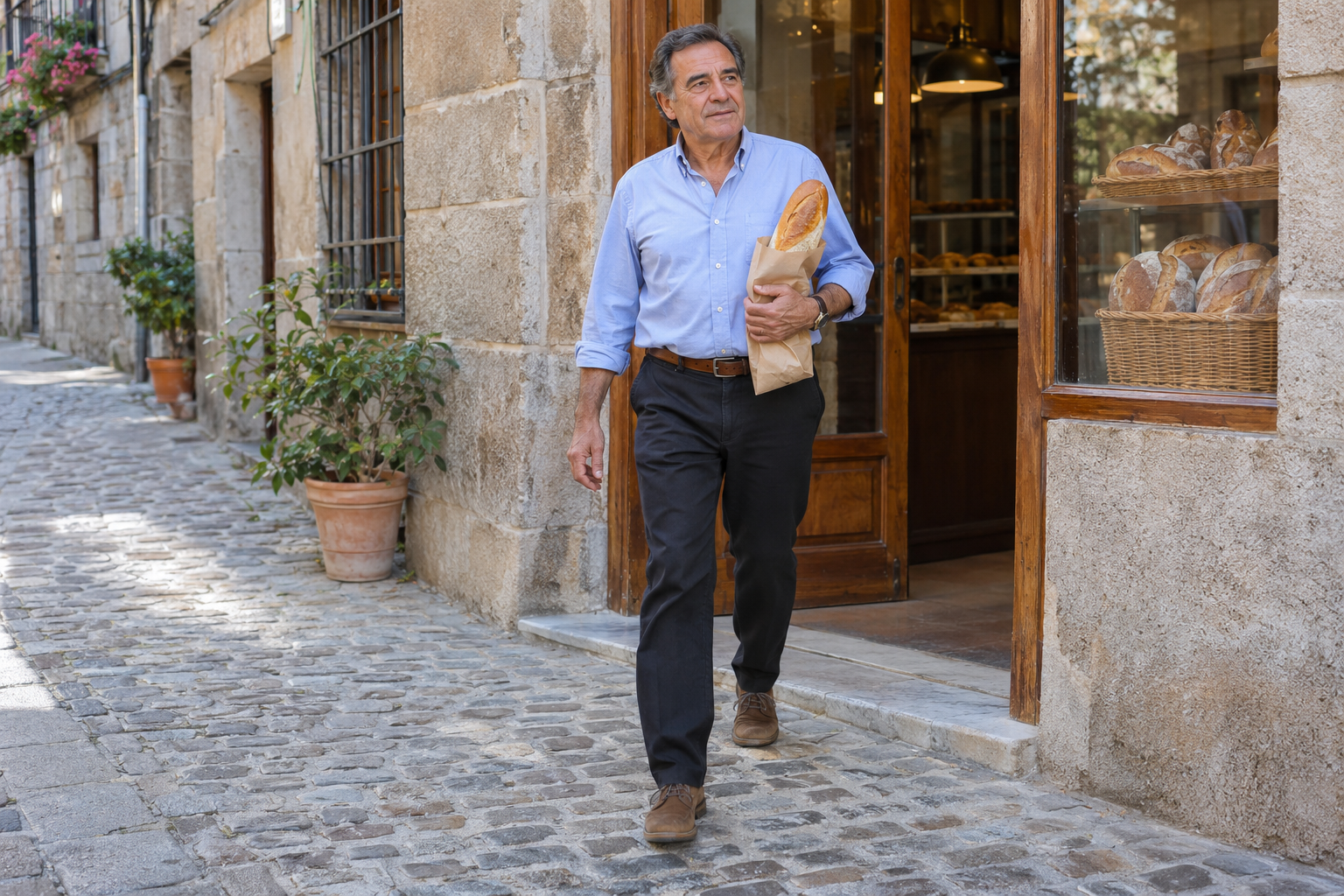
Call it the bakery test, because the humble errand of buying bread is where the difference shows up most starkly. There is no occasion here, no reason to dress up, nothing to impress anyone; it is just a man getting a loaf. And that is precisely what makes it so revealing, because it strips away any special effort and shows you a man’s actual baseline.
The European man passes the test without thinking about it. For him, stepping onto the street to buy bread still calls for a shirt tucked in and a belt on, not because the bread deserves it but because that is simply how he is dressed when he leaves the house, even casually, even for nothing. The American man, by the same test, steps out untucked, beltless, and loose, in whatever was comfortable, because for him a quick errand is exactly the sort of occasion that calls for no effort at all. Neither man is thinking about it; both are just dressing the way they always do for a trivial outing, which is what makes the contrast so telling.
The bakery test works because it catches people at their most unguarded. Anyone can pull themselves together for a dinner or an event; the real difference is what a man wears when it does not matter, and there the European baseline of tucked-and-belted and the American baseline of untucked-and-loose stand clearly apart. The small rule is not about special occasions; it is about the ordinary ones, the bread runs and the errands, where the two cultures’ default settings are laid bare. And on those ordinary outings, the tucked shirt is doing more work than its owner realizes.
Tucked, Not Untucked
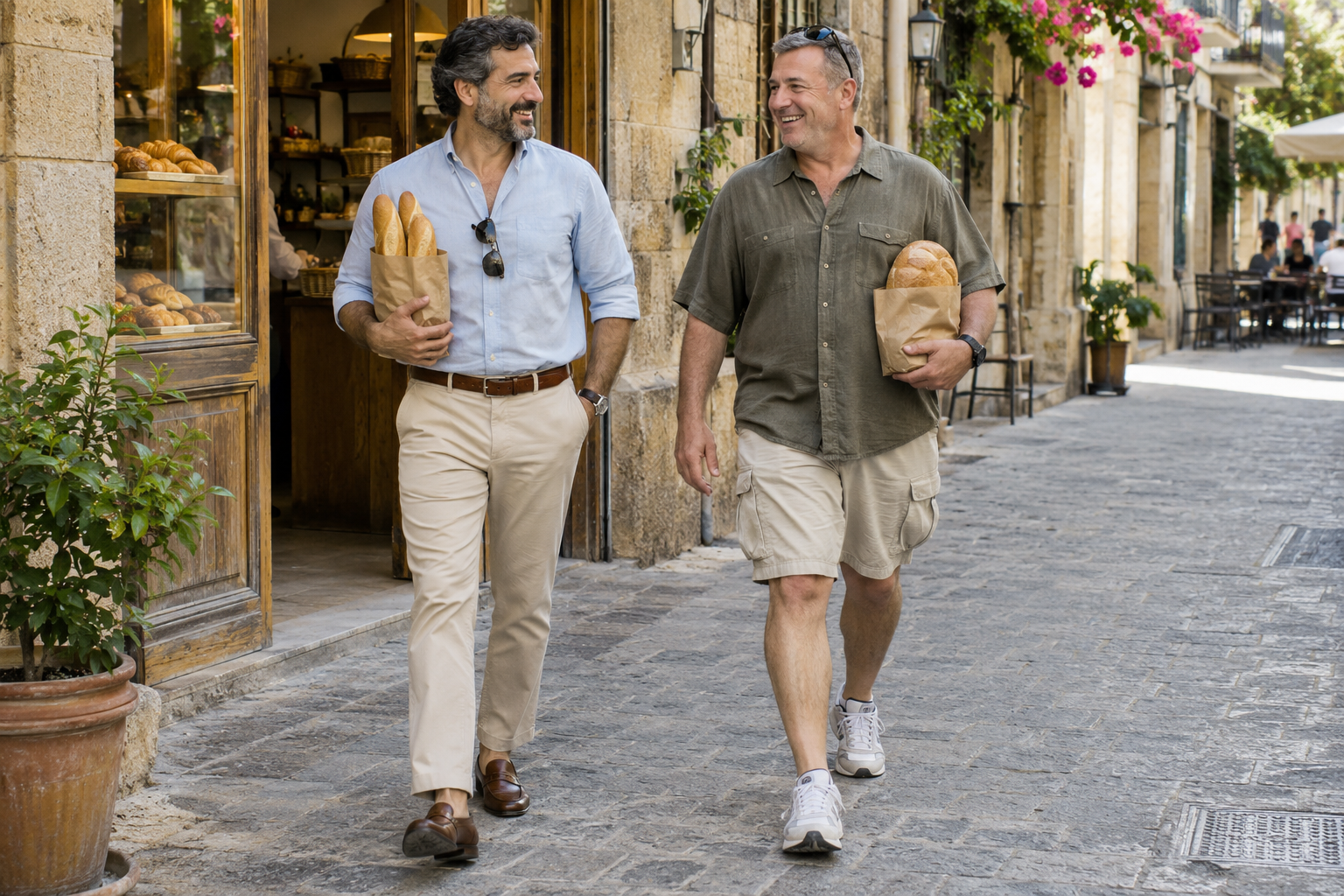
The heart of the whole thing is the tuck, and it is worth dwelling on because it is the single most visible difference and the one that does the most work. European men tuck their shirts into their trousers; American men, by strong default, leave them untucked, and that one choice shifts the entire impression a man gives.
The effect of the tuck is out of all proportion to the effort. A tucked shirt instantly reads as put-together, intentional, and grown-up; it defines the line of the body, looks deliberate rather than thrown-on, and signals a man who is dressed rather than merely covered.
An untucked shirt, by contrast, reads as casual at best and sloppy at worst, hanging loose and shapeless, and in a European context it reads, specifically, as touristy. The American habit of the untucked t-shirt or the untucked button-down flapping over the waistband is one of the most recognizable signatures of a visitor, precisely because local men so rarely do it. The same shirt, tucked, looks pulled-together; untucked, it looks like vacation.
This is the first and biggest lesson, and it is almost absurdly simple: tuck the shirt. There is genuine nuance to it, of course, some casual shirts are designed to be worn untucked, and the tuck works best with trousers and a proper shirt rather than a long tee, but the broad rule holds, and the broad rule is what separates the two looks. Where a European man’s instinct is to tuck, an American man’s is to leave it loose, and that single divergence accounts for more of the look-like-a-tourist effect than almost anything else a man wears. The tuck is small, free, and transformative.
The Belt Is Not Optional
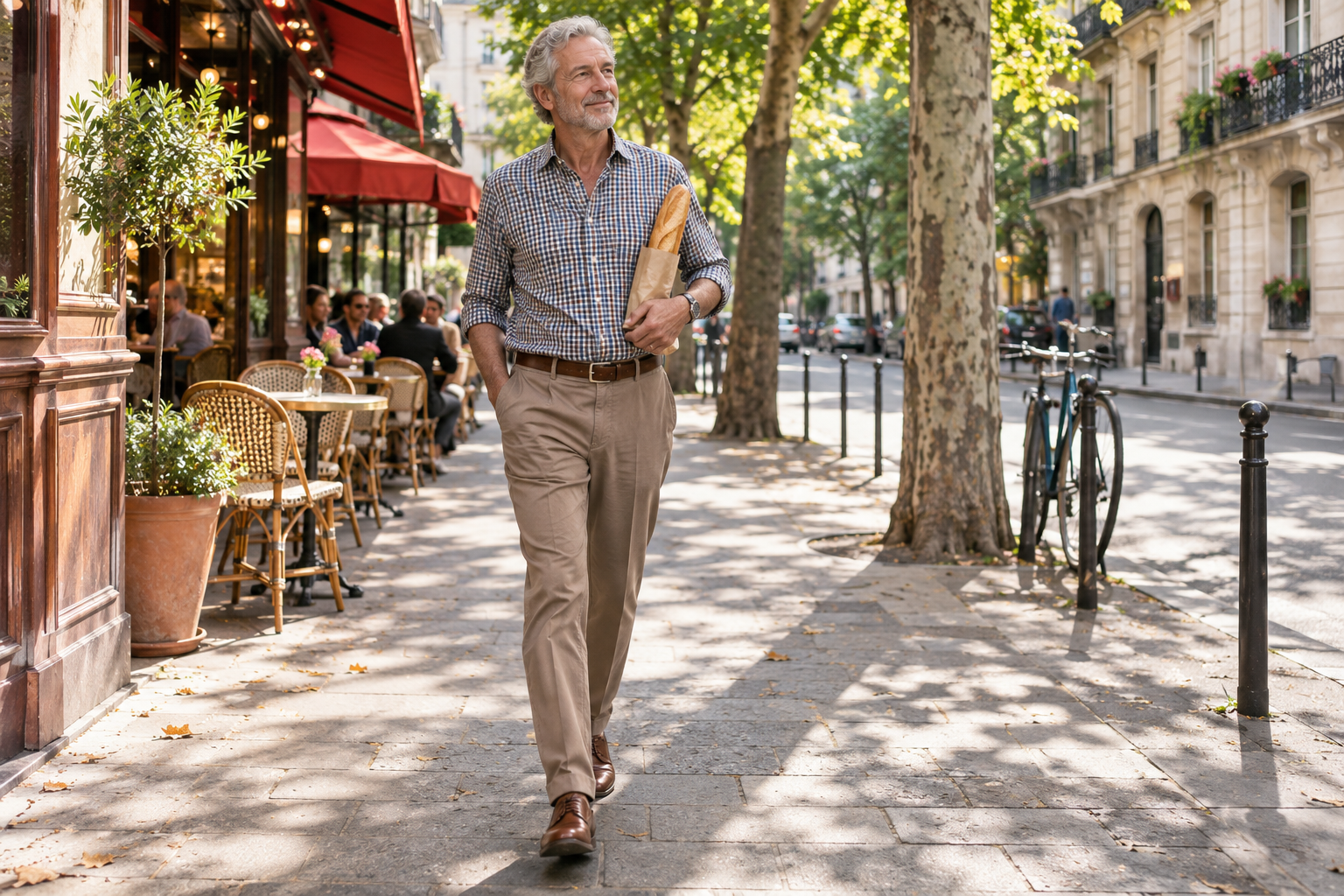
Hand in hand with the tuck goes the belt, because the two work together, and a tucked shirt without a belt looks oddly unfinished. For the European man, a belt is simply part of being dressed; for the American man, it is frequently an afterthought skipped entirely, and the gap shows.
The belt does real work in the look. A good leather belt finishes the waist, defines the line between shirt and trousers, and completes the tucked-in silhouette, lending the whole outfit a note of intention and polish.
It is the small detail that signals care, the final touch that says a man thought about how he looks, even a little. American men, by contrast, often skip the belt altogether, favoring elastic-waisted shorts and trousers, or simply not bothering, and the result is a waistline that looks unfinished and casual. Tucked trousers worn without a belt, with the belt loops sitting empty, actually look worse in a way than an untucked shirt, because they look incomplete, like a man who started getting dressed and stopped halfway.
So the belt is not an optional extra but a necessary partner to the tuck, the two forming a single small standard of a finished waist. A tucked shirt and a leather belt together produce the pulled-together look; either one without the other falls short. For the European man this is so automatic that he would feel undressed without a belt, the way he would feel undressed with his shirt hanging loose; for the American man, the belt is one more small thing easily left off. Adding it back is as cheap and as transformative as the tuck itself, and the two go together.
Why It Reads as Tourist
Step back and it becomes clear why the untucked, beltless, loose look reads so unmistakably as American tourist abroad, because it is part of a whole bundle of casual-American signals that locals recognize instantly. The flapping shirt and the empty belt loops sit right alongside the sneakers, the cargo shorts, the baseball cap, and the backpack as the uniform of the visitor.
The reason is context. In European cities, local men maintain a baseline of being reasonably put-together even for casual daily life, so the sight of an adult man in an untucked tee, shorts, and no belt stands out as someone who is plainly not dressed the way the locals dress for ordinary life. It reads as vacation mode, a man on holiday who has let the normal standards slide, which is of course exactly what he is, and that is why it functions as such a reliable tell. The look says, as clearly as an accent, that this is a tourist relaxing far from home rather than a local going about his day, because local men simply do not present themselves that way even for the humblest errand.
None of this means anyone is judging the tourist harshly, and there is nothing wrong with being recognizably on holiday. But for the man who would rather not broadcast tourist with every step, or who simply wants to look more put-together, the untucked-and-beltless look is one of the easiest tells to drop. It marks you not because it is bad but because it is so different from the local baseline, and closing that gap is a matter of two small, free adjustments. The tell is loud, but it is also, happily, the easiest kind to fix.
It Is a Baseline, Not Dressing Up
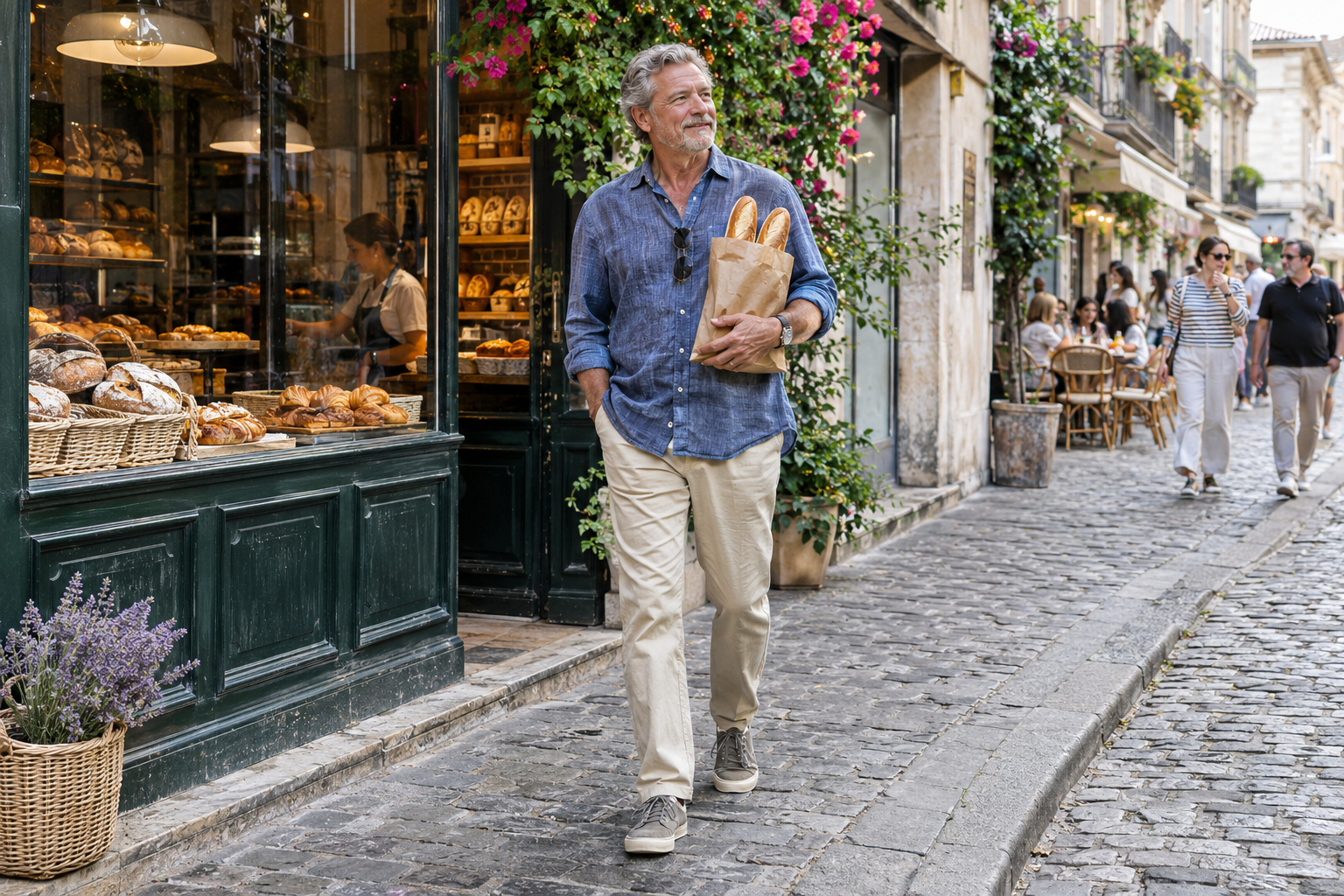
Here is the crucial thing to understand, the insight that makes the whole rule click into place: the European man is not dressing up to buy bread. He is not making an effort, not putting on anything special, not treating the errand as an occasion. Tucked and belted is simply his baseline, his version of casual, the floor below which he does not drop.
This is the part Americans most often miss. To an American, a tucked shirt and a belt can feel like dressing up, a step above casual, something you do for work or a nice dinner, so the idea of doing it to buy bread seems absurdly formal.
But to the European man it is nothing of the kind; it is just how a grown man is dressed, even at his most casual, the ordinary baseline of being presentable in public. The whole level is set higher: his casual is tucked and belted, where the American’s casual is untucked and loose, so what looks like effort to the American is simply the resting state for the European. He is not dressing up for the bakery; he is just dressed, as he always is.
This connects to the broader European instinct that runs through so much of how people present themselves on the continent, the sense that appearing in public, even for the most trivial reason, calls for a baseline of looking put-together. The tucked shirt and the belt are the male, everyday expression of the same impulse that puts European women in real clothes rather than gym wear for errands and finishes their outfits with a scarf or a good bag. It is not vanity or formality; it is simply a higher floor for ordinary public presentation, absorbed so early that it feels like nothing. The European man tucks and belts to buy bread for the same reason he would never run that errand in his pajamas: it is just not done.
The American Comfort Default
In fairness, the American default has its own entirely reasonable logic, and it would be wrong to cast the untucked, beltless look as simply a failure. It comes from a genuine and appealing American value, the deep preference for comfort, ease, and casualness over formality.
The American instinct is defensible on its own terms. The untucked shirt is comfortable and relaxed, the elastic waist is easy, skipping the belt is one less thing to bother with, and the whole loose, casual approach reflects a culture that prizes being comfortable and unfussy, especially on a day off or a quick errand. There is something democratic and easygoing in the American refusal to stand on ceremony for a trip to the shops, a sense that a man should be able to be comfortable without anyone minding, and that is not a bad value to hold. The American man dressing down for an errand is expressing a real and reasonable preference for ease over presentation, not failing at something he was trying to do.
So this is, once more, a difference of baselines and values rather than a matter of right and wrong. The European baseline prioritizes looking put-together even casually; the American baseline prioritizes comfort and ease even in public; and each gives up a little of the other. Americans trade a bit of polish for a lot of comfort, which is a perfectly respectable bargain, and no man should feel bad for valuing ease. The point is not that the American default is wrong, but that it is a lower floor for public presentation than the European one, which is exactly why an American operating on it stands out abroad.
The Easiest Upgrade a Man Can Make
For the man who likes the idea of looking a little more put-together, or a little less like a tourist, here is the genuinely good news, and it is the best part of the whole rule: fixing it costs nothing. The tuck and the belt require buying absolutely nothing, because you already own the shirt and almost certainly own a belt; they require only the small habit of using them.
This makes it perhaps the single highest-value, lowest-cost change a man can make to how he looks. Every other style upgrade involves buying something, a better coat, good shoes, a quality knit, but this one is free, a matter of tucking in the shirt you were going to wear anyway and putting on the belt already in your drawer. The payoff is wildly out of proportion to the effort: that one small adjustment instantly makes a man look more pulled-together, more grown-up, and markedly less like a tourist, transforming the same clothes into a better impression at no cost and almost no trouble. There is no cheaper or easier way for a man to upgrade his look, because there is nothing to buy and nothing to learn, only a two-second habit to adopt.
So take it or leave it as your days and your comfort dictate, but know that the option is there and that it is free. On the days or in the settings where you would like to look more put-together, or simply to blend in rather than broadcast tourist, tuck in your shirt and put on a belt, and you will have borrowed the small daily standard that makes European men look so effortlessly pulled-together even buying bread.
On the days when comfort wins and you would rather hang loose, do that instead, with a clear conscience. The rule asks nothing of your wallet and little of your effort; it only offers a surprisingly large improvement in exchange for two small habits you can pick up this afternoon. For the price of tucking in a shirt, a man can look like he belongs, which is about the best bargain in all of dressing.

About the Author: Ruben, co-founder of Gamintraveler.com since 2014, is a seasoned traveler from Spain who has explored over 100 countries since 2009. Known for his extensive travel adventures across South America, Europe, the US, Australia, New Zealand, Asia, and Africa, Ruben combines his passion for adventurous yet sustainable living with his love for cycling, highlighted by his remarkable 5-month bicycle journey from Spain to Norway. He currently resides in Spain, where he continues sharing his travel experiences with his partner, Rachel, and their son, Han.