
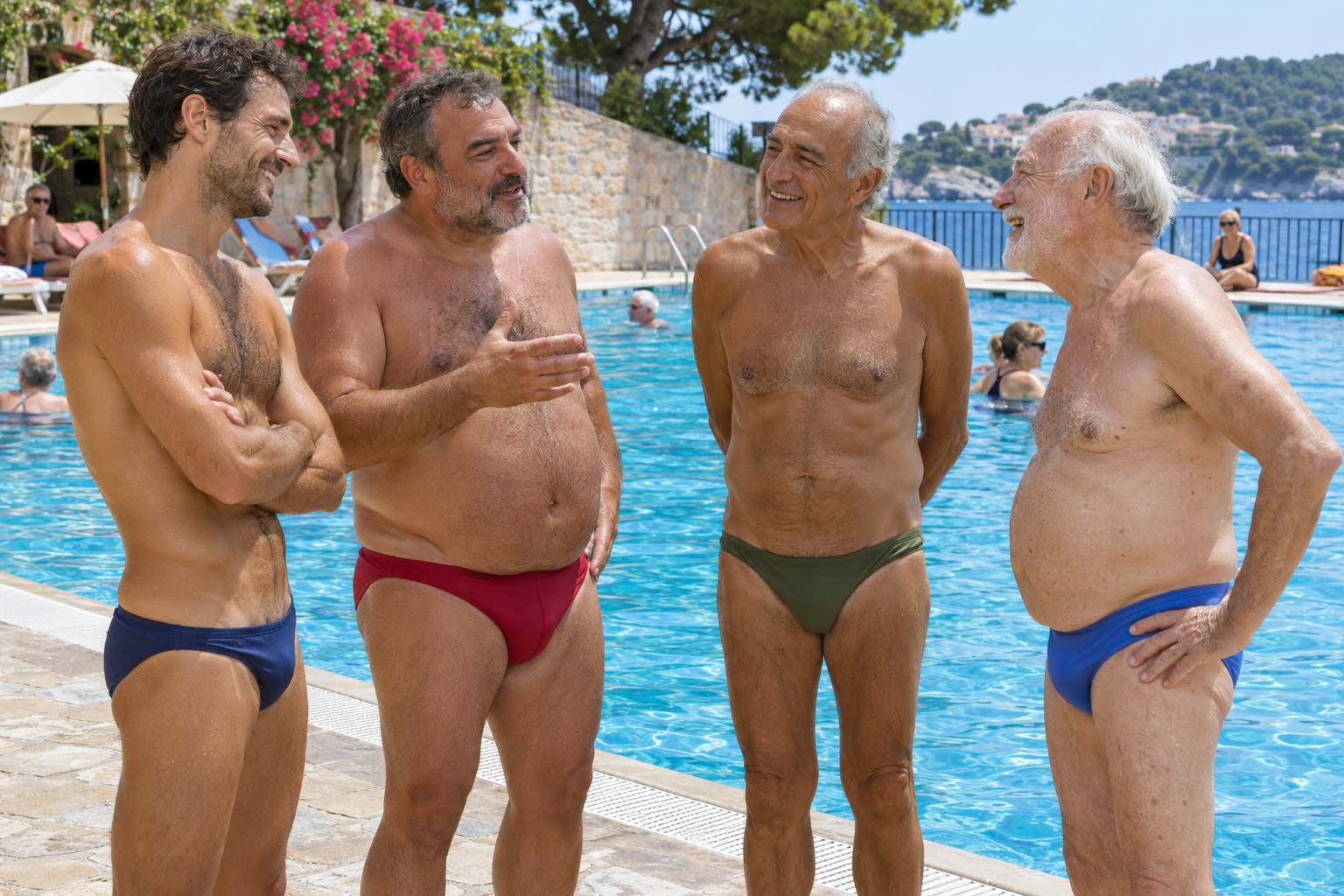
Spend a day at a European pool or a Mediterranean beach and you will notice something that quietly astonishes most American visitors. The men, all of them, of every possible age and shape and size, are wearing speedos. The lean twenty-five-year-old, yes, but also the seventy-five-year-old with a round belly and thin legs, the middle-aged father, the wiry grandfather, all of them in snug little swim briefs, and not one of them looks the least bit embarrassed about it.
The American man, standing nearby in his long, baggy, knee-length board shorts, finds this genuinely bewildering, and often a little scandalizing. To him, the speedo is something only athletes or the very vain or very brave would wear, a garment that exposes far too much and invites judgment, and the idea of an ordinary older man in one, perfectly relaxed, is almost unthinkable. And yet there they are, the European men, entirely at ease in their own skin.
Here is the thing, though: the real story is not the swimwear at all. It is the astonishing, enviable body-confidence underneath it, the complete absence of embarrassment that lets a man of any age and any shape wear whatever he likes to the water and simply enjoy himself. Here is the speedo divide, what sits behind it, and the quietly beautiful lesson it holds.
The Speedo Is Just Normal
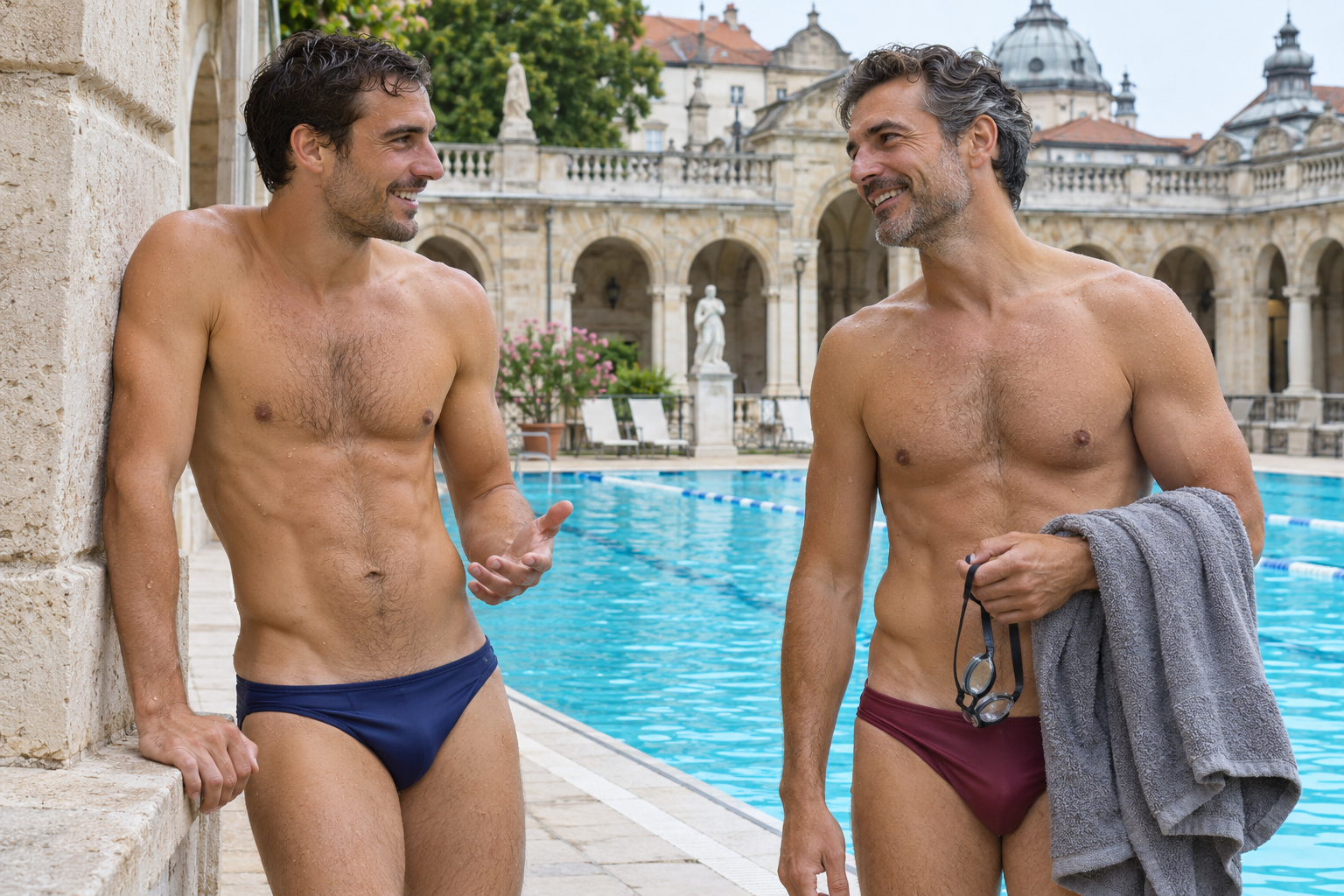
Start with the plain fact, because it surprises Americans so much: in Europe, and especially around the Mediterranean, brief swimwear is simply the normal thing men wear to swim. The speedo, or something like it, is not a statement, not a provocation, not reserved for competitive swimmers or show-offs; it is just what a great many ordinary European men put on to get in the water.
This is a genuine cultural default, not a fringe choice. At pools and beaches across much of Europe, snug swim briefs are standard men’s swimwear across the whole population, worn by regular men of every description going about the ordinary business of a swim, and there is no sense that wearing one is daring or notable; it is as unremarkable as a woman wearing a swimsuit.
In some places you will even find that the long American-style board shorts are the odd ones out, occasionally even discouraged at public pools on hygiene grounds, with the brief being the expected norm. The American who turns up in his baggy knee-length shorts, expecting to blend in, can find himself the one drawing the curious glances.
This flips the whole American frame of reference. In the United States, the long board short is the default and the speedo is the exception, the thing that draws stares, so Americans arrive assuming the brief is inherently a bold or questionable choice. In much of Europe it is exactly the reverse: the brief is normal and unremarked, and it is the man in the baggy knee-length shorts who looks slightly out of place. Understanding that the speedo is simply ordinary swimwear there, carrying none of the baggage it carries in America, is the first step to understanding why nobody wearing one feels any need to be embarrassed.
No One Is Embarrassed
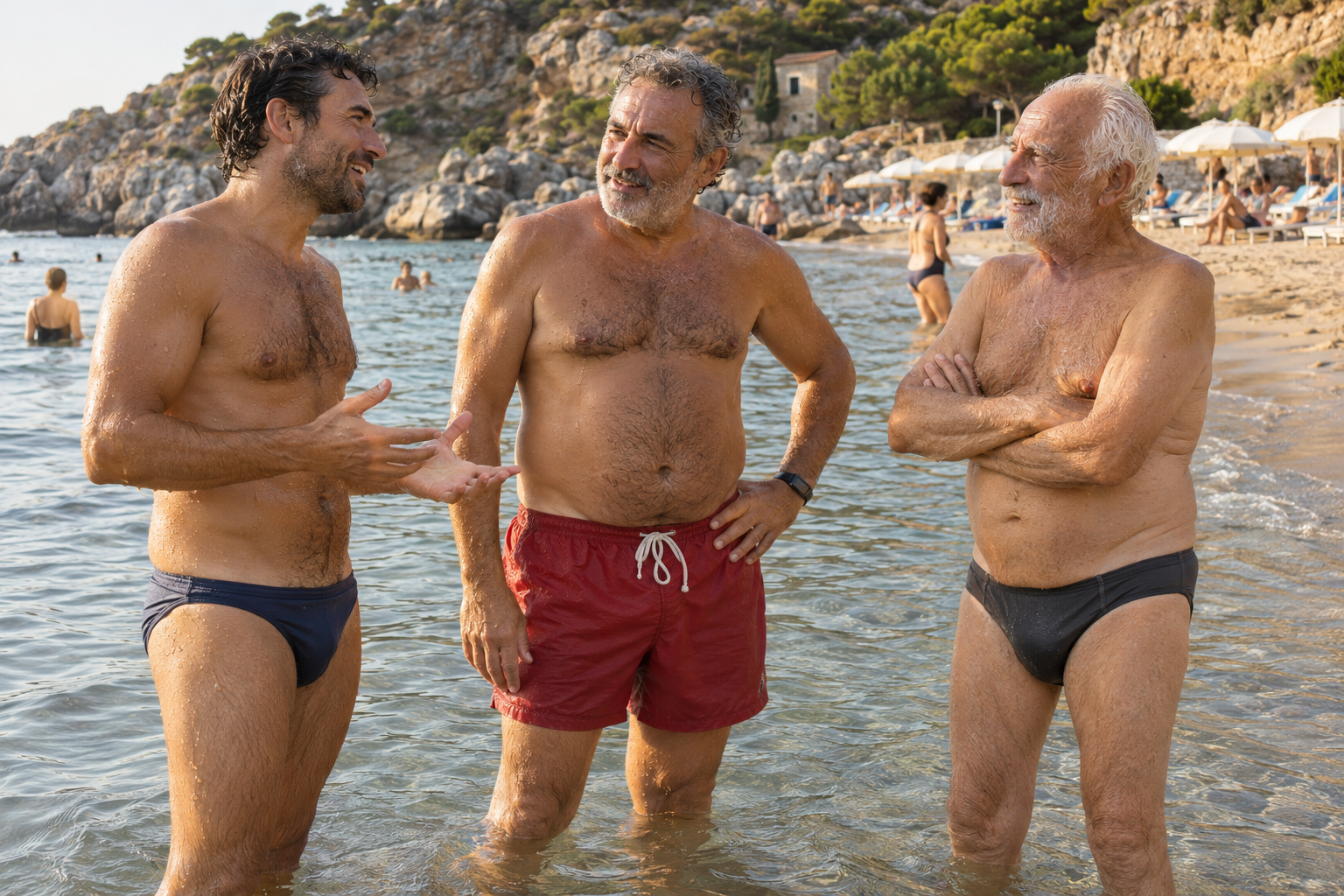
But the normalcy of the garment is only half of it. The truly striking thing, the part that stays with American visitors, is that the men wearing these revealing little briefs are completely unselfconscious about it, regardless of what their bodies look like. This is where the real marvel lies.
Look closely and you see it on every kind of body. The older man with a sizable belly, the skinny old fellow, the hairy one, the pale one, the one who by American beach standards would be mortified to show so much, all of them wear their briefs with exactly the same unbothered ease as the young and the fit. There is no hiding, no sucking in, no air of apology or defiance, just men of every shape enjoying the water in minimal swimwear as though it were the most natural thing in the world, which to them it is. The seventy-year-old in a speedo is not being brave or making a point; he is simply swimming, dressed the way he has always dressed to swim, and the thought that his aging body might be something to conceal does not appear to cross his mind.
This is what genuinely astonishes Americans, far more than the garment itself: the sheer absence of body shame. In a culture where so many people, and perhaps especially older people, feel they must cover and hide an imperfect or aging body, the sight of men of every age and shape displaying theirs without a flicker of embarrassment is almost startling. It is not that these men all have bodies worth showing off by some magazine standard; it is that they do not appear to believe their bodies need justifying at all. The confidence is not in the physique; it is in the complete freedom from caring, and that freedom is the thing worth looking at.
Why Americans Clutch Their Board Shorts
To appreciate how remarkable that ease is, it helps to look at the American side, at why American men cling so firmly to their long, concealing board shorts. The baggy knee-length short is not an accident of fashion; it reflects a whole set of attitudes about the male body.
A good deal of it is modesty and body-consciousness. American culture carries a certain discomfort with the male body on display, and the long board short functions as a kind of armor, covering the thighs, obscuring the shape, and generally minimizing how much of the body is shown, which many men find reassuring. There is also the specific cultural coding of the speedo in America, where it has long been associated with the idea of being too revealing, vaguely un-masculine, or even faintly ridiculous, so that an ordinary straight American man would feel exposed and self-conscious wearing one in a way he never would in shorts. The board short lets him be at the beach without feeling that his body is on show, which, in a culture that has taught him to be a little ashamed of it, feels safer.
Underneath that is a broader American unease about bodies, aging, and nakedness that the board short quietly expresses. The instinct to cover up, to hide the belly and the thighs and the signs of age, to treat the near-naked body as something potentially embarrassing to be managed, is deeply ingrained, and the long shorts are its uniform. The American man is not necessarily more modest by nature than the European; he has absorbed a culture that is more anxious about the body, and he dresses for the water accordingly. The board short is comfortable partly because it keeps that anxiety at bay.
It Is Cultural, Not Physical
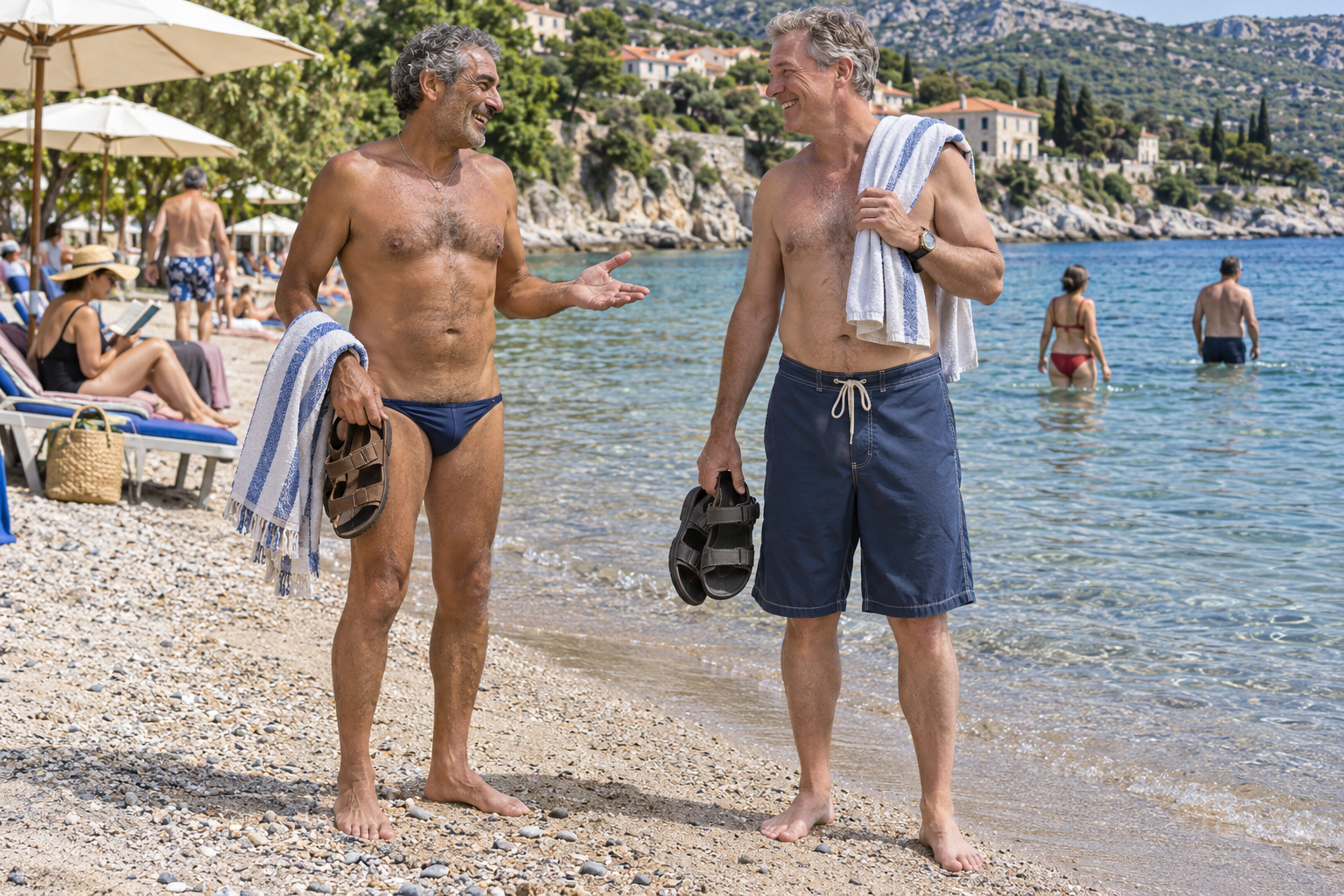
The crucial thing to understand, and the thing that reframes the whole comparison, is that this is not about European men having better bodies. It is tempting for an American to assume the speedo-wearers must be fitter or more attractive, but a day at any European beach disproves that instantly; the bodies on display are as ordinary, as aged, and as imperfect as anywhere. The difference is not in the bodies but in the relationship with them.
Europe, broadly, has a more relaxed and less anxious relationship with the body, with nudity and near-nudity, than America does. This is the same cultural current that produces topless sunbathing on European beaches, mixed and often nude saunas in the north, naturist beaches, and a general sense that an unclothed or barely-clothed body is simply a body, not something charged with shame or scandal. In that context, a man in a speedo is wearing rather more than many people around him, and the idea that his near-naked form should embarrass him makes little cultural sense. The body is not freighted with the same anxiety, so there is nothing to be embarrassed about.
So the speedo divide is really a window onto two different cultural relationships with the human body, one more relaxed and accepting, one more anxious and concealing. The European man’s ease is not a personal triumph of confidence he worked for; it is the natural result of growing up in a culture that never taught him his body was a problem in the first place. And the American man’s board-short armor is not personal cowardice; it is the natural result of growing up in a culture that did. Seeing that the difference is cultural rather than physical is what turns the whole thing from a comment on bodies into something more useful: a glimpse of a healthier attitude that can, to some degree, be learned.
The Practical Case, Too
It would be unfair to leave out that there are genuine practical considerations on both sides, because the choice of swimwear is not only about confidence. The speedo and the board short each have real functional merits, and the garment question is not purely a matter of attitude.
The brief has practical virtues for actual swimming. It creates far less drag in the water, which is exactly why competitive swimmers wear minimal suits, it dries quickly, and it is simply less cumbersome for doing laps or swimming properly rather than wading and lounging. For a man who actually swims, the brief is arguably the more functional garment, which is part of why it became the European default in a swimming-centered beach culture. The board short, for its part, has its own real advantages: it offers sun protection for the thighs, it suits surfing and active water sports, and it doubles easily as casual shorts for walking around, which fits a different, more all-purpose beach culture.
So neither garment is simply right, and the point of all this is not to insist that men everywhere should switch to speedos. The practical case cuts both ways, and comfort, climate, and what you are actually doing in the water all legitimately shape the choice. The real story was never that the speedo is the correct swimwear; it is that the European non-embarrassment, the freedom to wear whatever one likes to the water without shame, is the thing worth envying, quite apart from which garment a man ultimately chooses. The lesson is in the attitude, not the Lycra.
What It Teaches

Step back from the swimwear entirely, and what the European beach offers is a genuinely lovely lesson, one that matters far beyond the pool. It is the sight of men of every age and every shape enjoying the water, the sun, and their own lives without letting self-consciousness about their bodies hold them back for a single second.
This is worth dwelling on, because body shame keeps so many people, and older people especially, out of the water and out of the fun. Countless Americans, men and women both, deny themselves the simple pleasures of swimming, sunbathing, and the beach because they feel too self-conscious about an aging, heavier, or imperfect body to be seen in swimwear at all, and so they cover up, hang back, or stay away entirely. The European men in their speedos are a living rebuke to that whole sad habit. They demonstrate, every summer day, that you can have an ordinary, aging, unremarkable body and still stride down to the sea and enjoy it fully, because your body was never the price of admission to your own life.
That is the real gift hiding behind the speedo, and it is available to anyone regardless of what they choose to wear. The freedom is not in the brief; it is in the decision to stop letting embarrassment about your body govern what you allow yourself to do and enjoy. The seventy-year-old wading happily into the Mediterranean in his little trunks has not won some genetic lottery; he has simply never agreed to be ashamed, and in not agreeing, he gets to spend his old age in the water instead of hiding from it. That is a choice, and it is one anyone can make.
Wear What Lets You Enjoy the Water
So where does all this leave the American man, or anyone, standing at the edge of a European beach? Not, necessarily, in a speedo, because the point was never to prescribe a garment. Wear whatever you are genuinely comfortable in; if board shorts are your preference, wear them with a clear conscience, because comfort in your own swimwear is exactly what this is about.
What is worth borrowing is not the brief but the attitude underneath it, the refusal to let self-consciousness about an aging or imperfect body keep you out of the water and away from the pleasures of the beach. You can keep your long shorts and still take the real lesson, which is to stop treating your body as something that disqualifies you from enjoying the sun and the sea, and to simply get in, as you are, and have a wonderful time. The European men are not telling you what to wear; they are showing you how to feel, which is unbothered, and that feeling fits every body and every garment.
In the end, the men who wear speedos at every age without embarrassment are modeling something most of us could use more of: the plain confidence to inhabit our own bodies, whatever they look like, and to let them carry us into the water and the sunshine and the fun without apology. Borrow that, whatever you choose to wear over it, and you will have taken the best of what the European beach has to teach. Get in the water, enjoy your one body and your one life, and let the self-consciousness stay on the shore.

About the Author: Ruben, co-founder of Gamintraveler.com since 2014, is a seasoned traveler from Spain who has explored over 100 countries since 2009. Known for his extensive travel adventures across South America, Europe, the US, Australia, New Zealand, Asia, and Africa, Ruben combines his passion for adventurous yet sustainable living with his love for cycling, highlighted by his remarkable 5-month bicycle journey from Spain to Norway. He currently resides in Spain, where he continues sharing his travel experiences with his partner, Rachel, and their son, Han.