
An American’s first trip to a German supermarket often ends in quiet confusion at the checkout, when the water they are buying costs a little more than the shelf price said it would. The extra is not a tax and not a mistake. It is Pfand, a deposit, added to almost every drink bottle and can in the country, and the clever part is that you get it back. Bring the empty bottle back to the shop, feed it into a machine, and the deposit returns to you, which is why Germans guard their empties like small change and why you will see people doing things with bottles that make no sense until you understand the system.
Pfand is one of those everyday German institutions that is completely invisible to locals and completely baffling to newcomers, and getting it wrong is a rite of passage, whether that means throwing away money in a bottle you should have returned or jamming the wrong bottle into a machine that spits it back out. It is also, once you understand it, genuinely admirable, a system that makes recycling almost automatic and that quietly supports some of society’s most vulnerable people in a way no American equivalent does. Here is what Pfand actually is, the two kinds you need to tell apart, how the return machines work, the touching custom of bottles left beside bins, and how to stop getting it wrong.
A Deposit on Your Drink
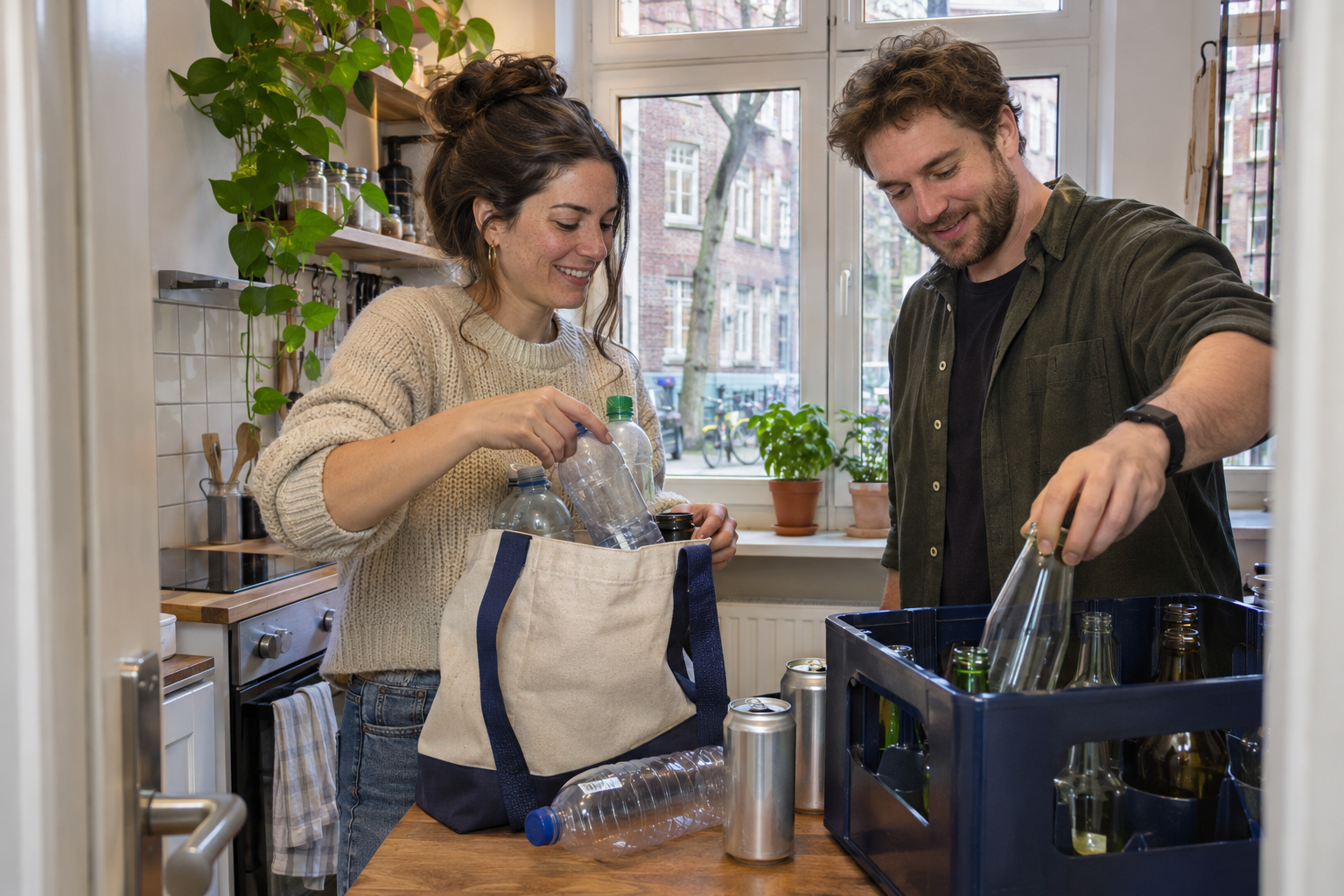
At its simplest, Pfand is a refundable deposit charged on drink containers. When you buy a bottle of water, a can of soda, or a crate of beer, a small extra amount is added to the price, and that amount is returned to you when you bring the empty container back. You are not buying the bottle, in effect. You are borrowing it, with a deposit held against its return, exactly like the glass milk bottles of an earlier American era, but applied across almost the entire drinks aisle.
The purpose is environmental, and it is blunt and effective. By attaching real money to every bottle and can, the system gives everyone a direct financial reason to return their empties rather than throw them away, which keeps containers out of the trash and in the recycling and reuse stream. A bottle with a deposit on it is not litter waiting to happen but money waiting to be reclaimed, and that simple reframing changes behavior across a whole country. Germans return their empties not out of virtue but out of thrift, and the environment benefits as a side effect.
The scale of it is what surprises newcomers. This is not a niche program for a few container types but a near-universal system covering most water, soft drink, beer, and other drink containers across the country. Once you live with it, you realize that empties are a form of currency in Germany, small amounts of real money sitting in every bottle, and you start treating them accordingly, saving them up, carrying them back, never casually binning one. The whole relationship with a drink container changes when it is worth money.
The Two Kinds You Must Tell Apart

Here is where newcomers get tripped up, because there is not one Pfand but two, and they work differently. Understanding the distinction is the key to the whole system. The two types are Einwegpfand, the deposit on single-use containers, and Mehrwegpfand, the deposit on reusable ones, and they exist for different reasons and carry different amounts.
Einwegpfand, one-way deposit, applies to single-use containers, most disposable plastic bottles and metal cans. The deposit on these is the higher one, a set amount of twenty-five cents on most of them, and the container is collected to be recycled, crushed, and remade rather than refilled. This is the deposit on the can of soda or the single plastic water bottle, and because it is relatively high, forgetting to return these is where you throw away the most money. The twenty-five cents adds up fast across a household’s worth of cans and bottles.
Mehrwegpfand, multi-use deposit, applies to reusable containers, the sturdy glass and thick plastic bottles designed to be washed and refilled many times. The deposit on these is usually lower, often around eight to fifteen cents per bottle, with a separate, larger deposit on the crate, the Kasten, that beer and water bottles come in. These bottles are not crushed but cleaned and refilled, sometimes dozens of times, which is even better environmentally than recycling. The classic German beer bottle, returned, washed, and refilled over and over, is the heart of this reusable system, and it is a genuinely circular one.
The practical trouble for a newcomer is telling which bottle carries which deposit, or any deposit at all, and the honest answer is that it takes a little learning. There are logos to look for, a particular mark indicating the one-way deposit, but plenty of exceptions exist, which brings us to the most confusing part.
What Does and Does Not Carry Pfand
Not every bottle in Germany has a deposit, and the exceptions are exactly where people get caught out. In general, water, soft drinks, beer, and many other drinks carry Pfand, but a number of categories traditionally do not, and the lines can feel arbitrary until you learn them.
Wine and spirits bottles typically carry no deposit. Many juice bottles and certain other drinks have historically been exempt. Milk containers have generally sat outside the system.
This patchwork means a newcomer genuinely cannot assume, and the safest habit is to look for the deposit logo on the label and to notice the Pfand line on your receipt when you buy. If a bottle carried a deposit when you bought it, your receipt will show it, and that same bottle is the one to bring back. A bottle that never had a deposit, like most wine bottles, simply goes into ordinary glass recycling instead, with no money attached. The rules have shifted over the years, generally expanding to cover more container types, so the safest approach is to check rather than to rely on an out-of-date mental map.
The reason this matters beyond mere confusion is money. Throw a deposit bottle in the regular bin and you have literally thrown away money, the twenty-five cents or the eight cents you paid and could have reclaimed. Multiply that across a household over a year and it becomes a real sum, which is exactly why Germans are so diligent about it and why the sight of a tourist casually binning a deposit can make a local wince. Learning which of your empties are worth money is the first real step to living with the system rather than fighting it.
Feeding the Machine
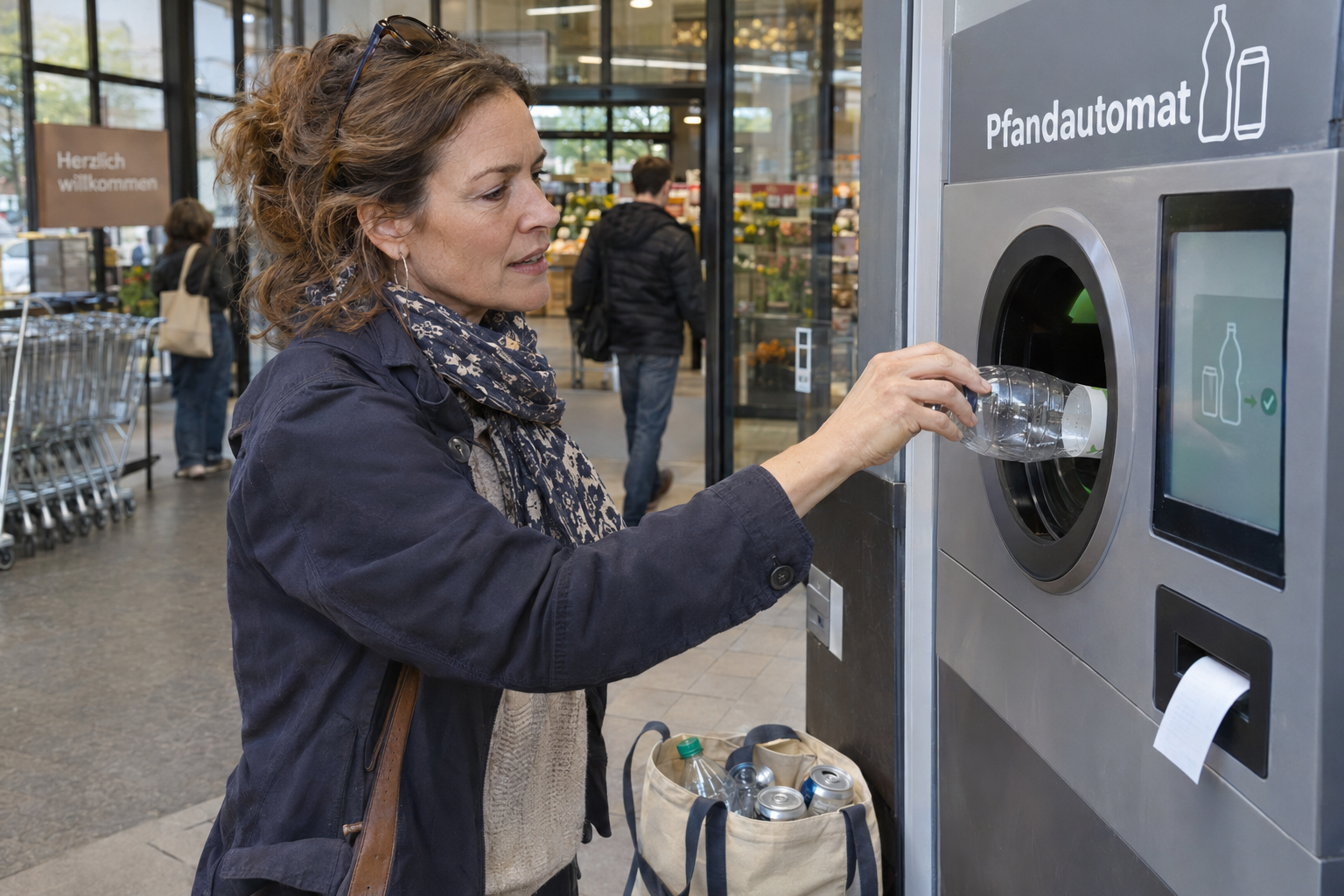
Returning your empties is done, for most single-use containers, through a machine, and the first encounter with one is its own small adventure. Most supermarkets have a Pfandautomat, a reverse vending machine, usually near the entrance, into which you feed your empty bottles and cans one by one. The machine reads each container, checks that it carries a deposit, and tallies up what it owes you, then prints a voucher.
The process is simple once you know it. You insert each bottle or can, usually into a round opening where it is scanned and often whisked away on a little conveyor, and the machine keeps a running total on its screen. When you have fed in all your empties, you press a button and it prints a Pfandbon, a deposit voucher, showing the total amount. You take that voucher to the checkout, where it is either paid out in cash or deducted from your shopping, so your returned bottles effectively pay for part of your groceries.
The machine can be finicky, and this is where newcomers stumble. It will reject a bottle that does not carry a deposit, one that is too crushed to scan, or one whose barcode it cannot read, spitting it back out with no explanation, which is baffling the first time it happens. The trick is to keep bottles reasonably intact and to feed in only deposit-carrying containers, and when a bottle is refused, it usually means it simply had no Pfand to begin with. For reusable bottles and crates, you often return them to a slightly different part of the system or hand them over at the counter, but the single-use machine is the one most people deal with most often, and mastering its quirks is a genuine part of settling into German life.
The Bottles Left Beside the Bin
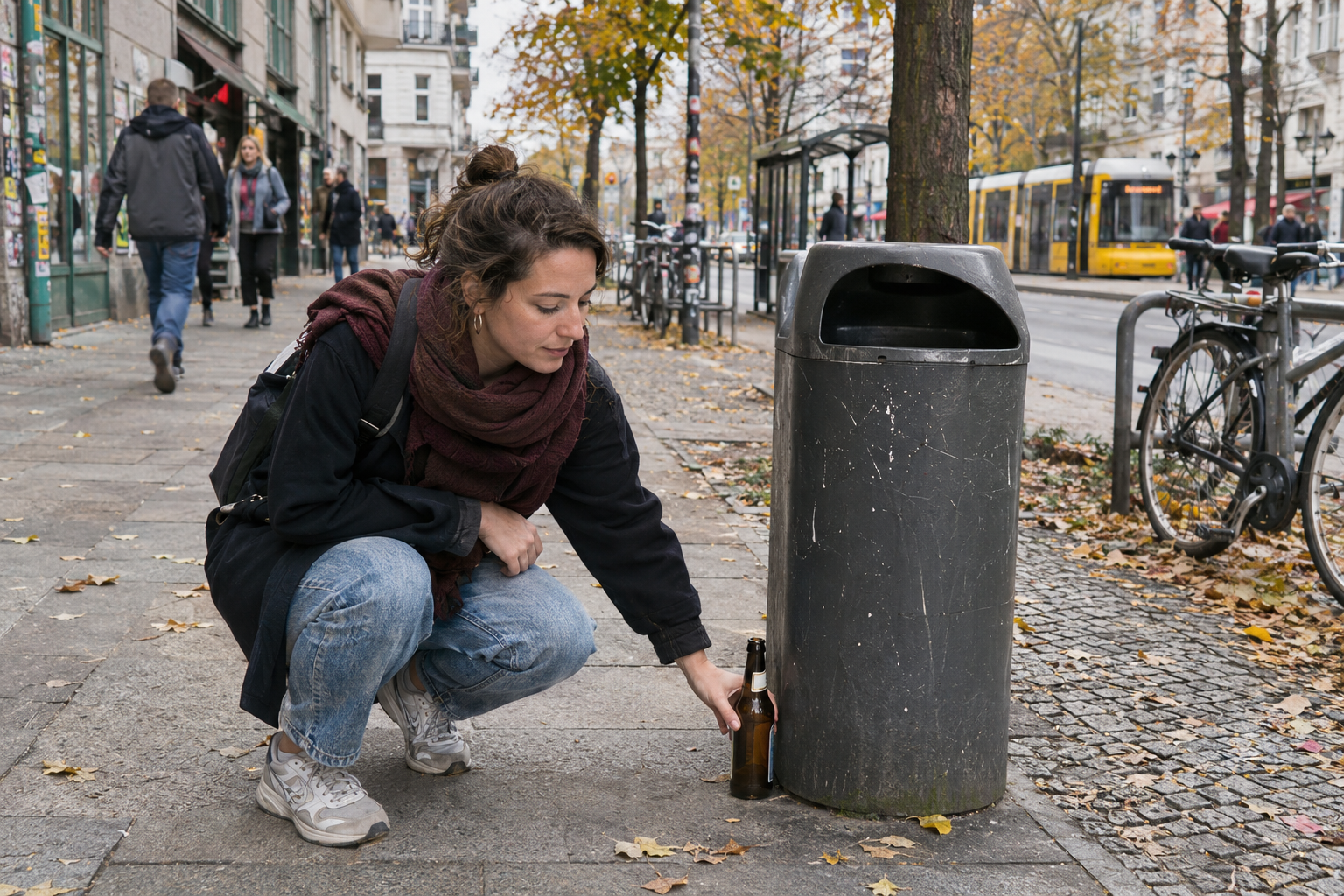
Now to the most quietly moving part of the whole system, the one that reveals something about German society. If you walk through any German city, you will notice that empty bottles are often placed next to public trash bins rather than inside them, set carefully on top or beside, as if on display. This looks strange until you understand it, and once you do, it is rather beautiful.
Because every deposit bottle is worth real money, there are people who make a little income by collecting them, going from bin to bin gathering empties to return for the deposit. These collectors, often elderly people on small pensions, or others who are struggling, are known as Pfandsammler or Flaschensammler, bottle collectors, and for some the deposits are a meaningful supplement to a thin income. Gathering bottles is a form of making ends meet that the deposit system quietly enables.
The custom of placing bottles beside the bin rather than in it exists precisely to help these collectors. By leaving your empty next to the bin, in plain sight and within easy reach, you let someone take the deposit without having to dig through the actual garbage, which preserves their dignity and makes the small act of charity easier. It is an unspoken social courtesy, widely understood and widely practiced, a way of passing on a little money to whoever needs it without any transaction or acknowledgment. People who do not want to bother returning their own bottles, or who simply want to help, leave them out this way as a matter of course.
There is something genuinely touching in this, a society-wide habit that turns a recycling mechanism into a quiet, dignified channel of mutual aid. The person leaving the bottle and the person collecting it never meet, no charity is announced, no gratitude is required, and yet a small transfer of money happens, over and over, across the whole country. It is one of those customs that tells you more about a place than any monument, and for a newcomer it is one of the most quietly affecting things to understand about daily German life.
Why It Works So Well

Step back and the German Pfand system is, by almost any measure, a striking environmental success, and it is worth appreciating why. By putting real money on containers, it achieves return rates that voluntary recycling never approaches, with the overwhelming majority of deposit bottles and cans brought back rather than thrown away or littered. When returning a bottle pays and binning it costs, people return bottles, and they do so at rates that make the system genuinely effective at keeping containers in the loop.
The reusable side is even better than the recycling side, because those sturdy refillable bottles are not melted down and remade but simply washed and filled again, many times over, which uses far fewer resources. A single reusable beer bottle might make dozens of trips from brewery to table and back, each time carried through the system by the small deposit attached to it. This circular, refill-based model is among the most resource-efficient ways to handle drink packaging that exists, and Germany runs it at national scale.
For Americans, used to recycling as a well-meaning but leaky voluntary effort, the German system is a revelation in how a simple financial incentive can transform behavior across an entire country. It is not powered by virtue or by lectures but by self-interest, the plain desire not to throw away money, and it works precisely because of that. Understanding Pfand is understanding something about how Germany approaches problems, with a practical, systematic, incentive-based solution that quietly makes the right behavior the easy and profitable one. For anyone moving there, learning to live with it is not a chore but an induction into one of the country’s genuine civic achievements.
Getting It Right as a Newcomer
If you are new to Germany, the way to stop getting Pfand wrong is to adopt a few simple habits and let the rest come with time. Keep your deposit bottles and cans separate from your other recycling, gather them up, and bring them back to any supermarket with a machine, where you will get your money back as a voucher. Do not crush them, do not bin them, and do not assume, since checking the receipt or the label tells you what carried a deposit.
When you cannot be bothered to return a bottle, or want to pass on the small kindness, leave it neatly beside a public bin rather than inside it, in keeping with the local custom, and someone will be glad of it. Expect the machine to reject the occasional bottle, usually because it never had a deposit, and do not take it personally. And give yourself a little time to learn which of your drinks carry Pfand and which do not, because that map is the thing that takes longest to build and is the source of most early confusion.
Do these things and you will quickly find the system becomes second nature, as invisible to you as it is to the locals, a small background rhythm of saving and returning that is simply part of German life. What begins as a baffling extra charge at the checkout becomes, with a little practice, one of the more satisfying everyday systems you will encounter anywhere, money that comes back, waste that is reclaimed, and a quiet thread of help running through it all. Among the many things that take adjusting to in Germany, Pfand is one of the most rewarding to finally get right.

About the Author: Ruben, co-founder of Gamintraveler.com since 2014, is a seasoned traveler from Spain who has explored over 100 countries since 2009. Known for his extensive travel adventures across South America, Europe, the US, Australia, New Zealand, Asia, and Africa, Ruben combines his passion for adventurous yet sustainable living with his love for cycling, highlighted by his remarkable 5-month bicycle journey from Spain to Norway. He currently resides in Spain, where he continues sharing his travel experiences with his partner, Rachel, and their son, Han.