
On a rugged Greek island in the Aegean, grandmothers in their late eighties and nineties go about their days much as they always have, tending gardens, brewing tea, walking to see neighbors, and quietly outliving almost everyone else their age in the wider world.
They are not exercising, dieting, or following any regimen, and if you asked them the secret to their long lives they would most likely just shrug and offer you something to eat. The island is Ikaria, nicknamed the place where people forget to die, and it is one of only a small handful of regions on earth, known as Blue Zones, where people reach ninety at strikingly high rates and stay sharp and active while they do it. Researchers have been flying out there for years to try to work out exactly why, cross-checking the islanders’ ages against old records to make sure the longevity is real, and it is. What they keep finding is not a miracle food or a secret supplement but a cluster of ordinary daily habits, repeated over a lifetime. That is the quietly radical lesson of Ikaria, that longevity there is not bought or hacked but simply lived, the slow accumulation of small good choices made without anyone thinking of them as choices at all. Here are nine of them, drawn from what the grandmothers of Ikaria actually do every day, along with an honest word at the end about what the science can and cannot really claim.
What follows is the plate that feeds them, the daily tea, the sacred nap, the movement built into the day, the web of people around them, the unhurried mind, and the crucial caveat about all of it.
The Plate That Feeds Them
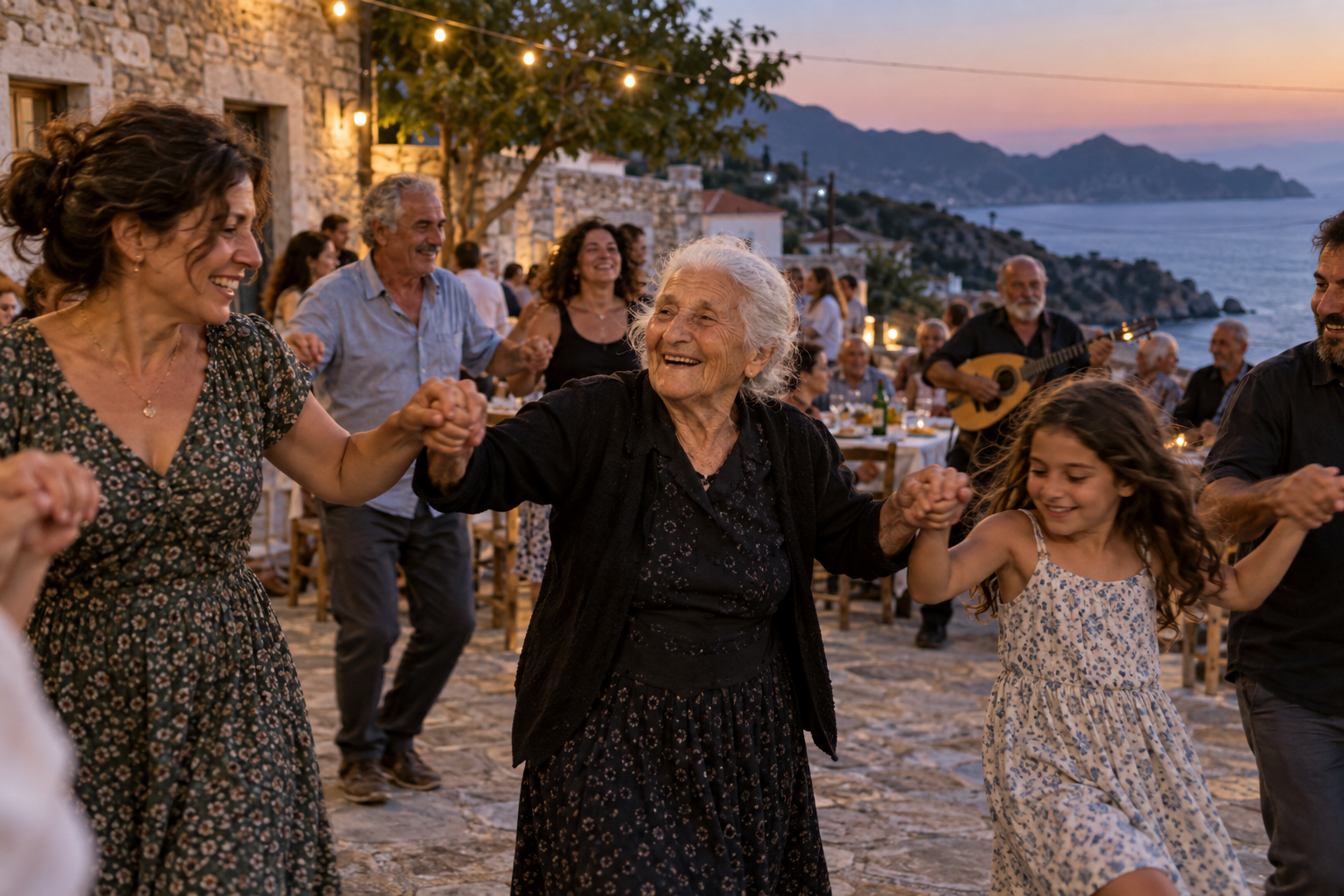
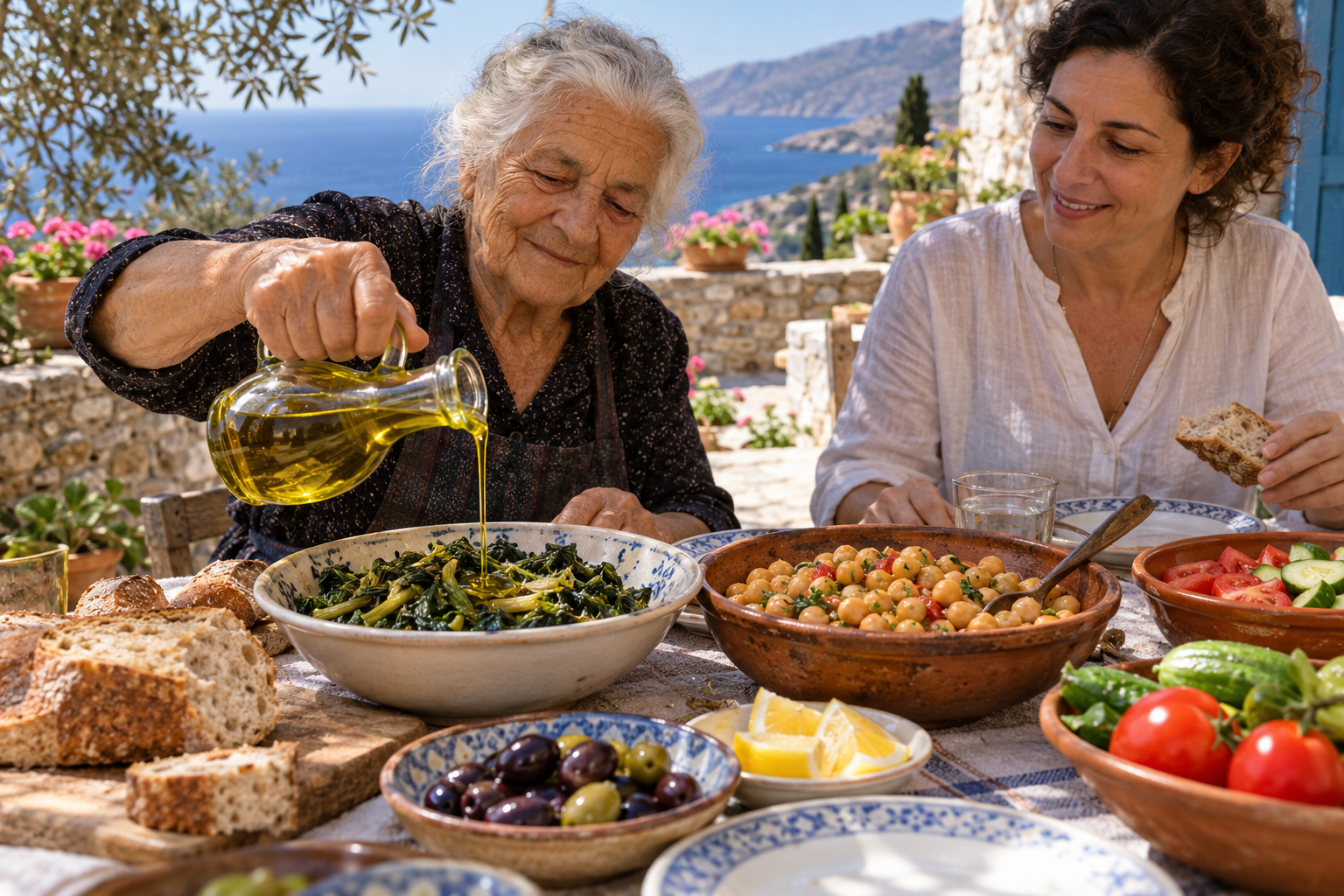
The first three habits sit on the Ikarian plate, and they are the foundation of everything. The first is a diet built overwhelmingly from plants, an extreme version of the Mediterranean way of eating, heavy on legumes like chickpeas, lentils, and black-eyed peas, on seasonal vegetables, and on very little meat, which appears only occasionally rather than daily. The islanders eat low on the food chain, filling their plates with beans and greens where a Western diet would center on meat, and fish turns up only a handful of times a month.
The second habit is the wild greens, or horta, that grow all over the island, gathered and eaten in enormous variety. Ikaria hosts scores of edible wild greens, many of them with antioxidant levels higher than red wine, and the grandmothers eat them constantly, boiled, in pies, and in stews, a free and abundant source of nutrition that most of the world has forgotten how to forage. The third habit is olive oil, used not as a careful drizzle but with abandon, poured over everything, so that a remarkable share of the islanders’ daily calories comes from this single good fat. Taken together, this plate, plants and beans, wild greens, and generous olive oil, is unlike almost any modern diet, and it is the single piece researchers point to most often, even as they caution that the diet alone does not tell the whole story. What is striking is how cheap and unglamorous it all is, beans and foraged greens and oil, the food of people who were never wealthy, which is a useful corrective to the idea that eating for a long life requires expensive superfoods.
The Daily Tea
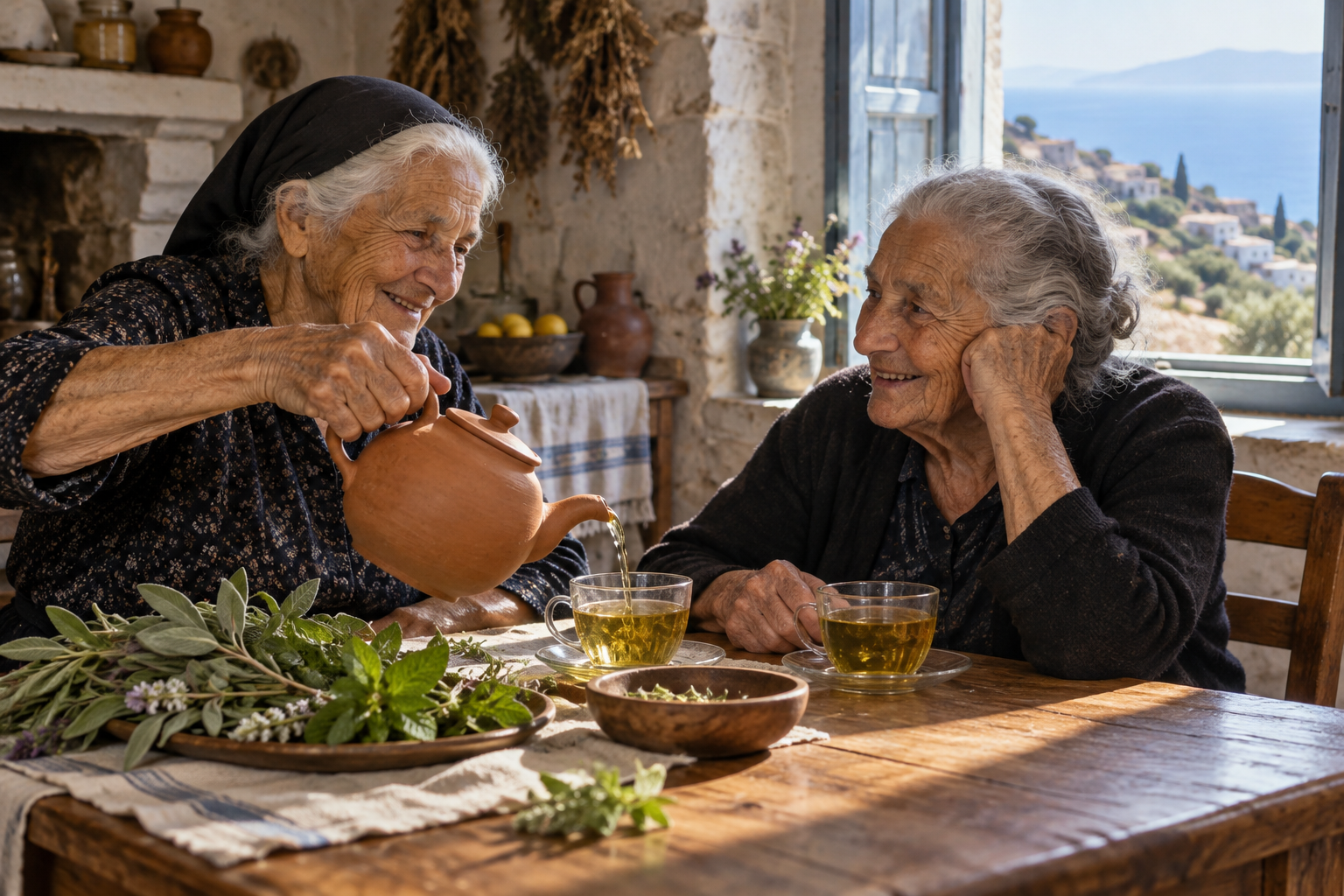
The fourth habit is one of the loveliest, and it doubles as both medicine and ritual: the daily herbal tea. Where much of the world reaches for coffee, the older people of Ikaria more often brew a tea from the wild herbs that grow around them, sage, rosemary, oregano, wild mint, and the local mountain tea, gathered from the hillsides and steeped fresh. It is a habit woven right through the day, a small warm pause repeated morning and evening.
The interesting part is that these are not merely pleasant drinks but mild, genuine remedies. The wild herbs the Ikarians favor carry real compounds, and their teas have been associated with modest effects like lowering blood pressure and easing inflammation, so a lifetime of drinking them may be quietly doing the body good in small daily doses. There is a social dimension too, since the tea is often shared, another thread in the constant contact between neighbors that defines island life. It is a simple thing, a cup of herb tea instead of a cup of coffee, but repeated across decades it is exactly the kind of small, sustained habit that Blue Zone researchers have learned to take seriously, and it costs nothing but the walk up the hill to gather the herbs. It is worth saying that the islanders do not drink these teas as a health regimen but simply because it is what they have always drunk, which is precisely why the habit endures where a self-conscious wellness routine would fizzle.
The Sacred Nap
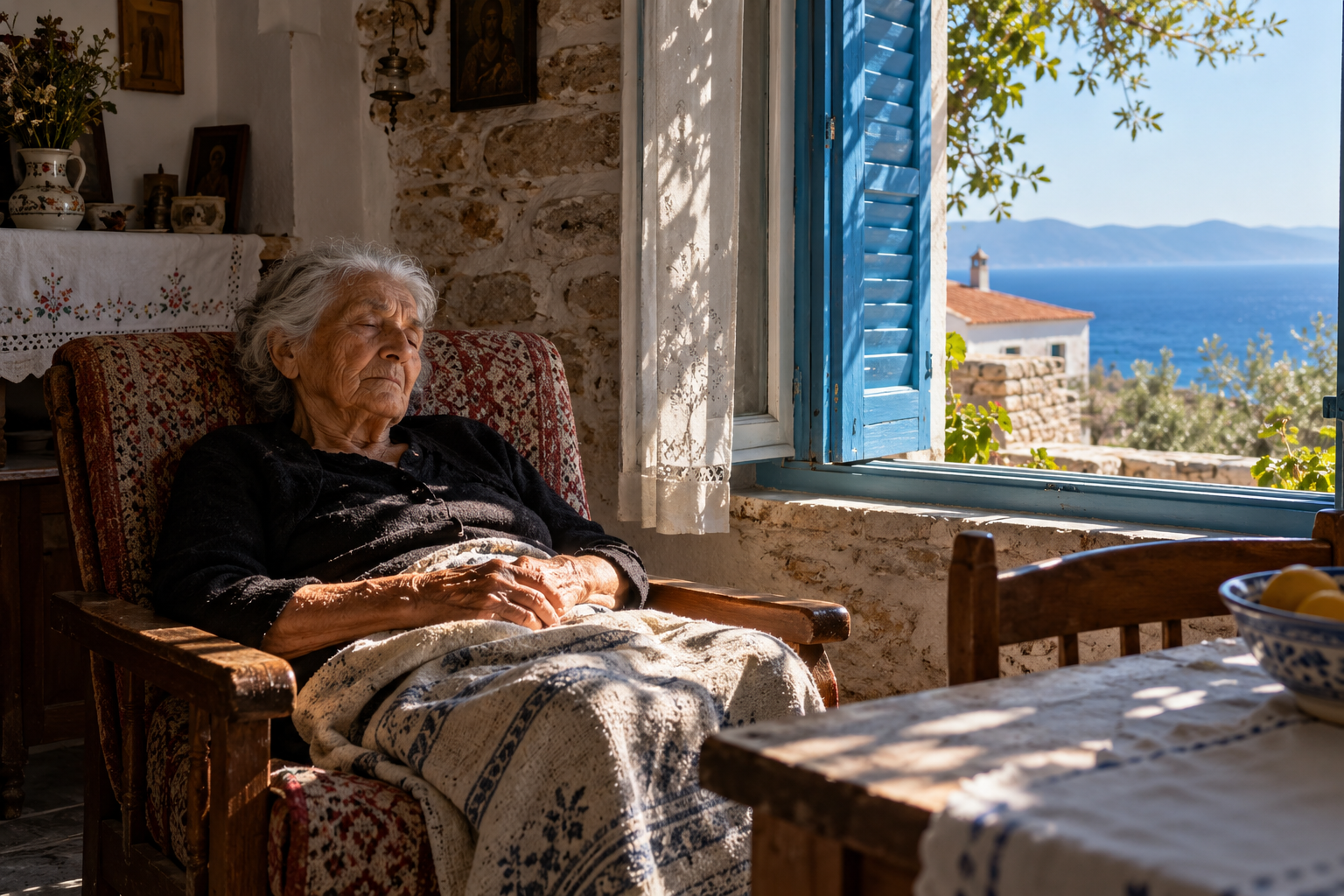
The fifth habit is the one most of the working world has abandoned to its cost: the afternoon nap. On Ikaria the midday rest is not an indulgence or a sign of laziness but a fixed and generational part of the day, taken as naturally as a meal, with the pace of life arranged to allow it. Shops may close, the heat is waited out, and older and younger islanders alike lie down for a while in the middle of the afternoon.
This is not just charming local color, because the nap has some of the most direct research behind it of any Ikarian habit. Studies of Greeks have linked regular afternoon napping to a substantially lower risk of dying from heart disease, on the order of a third lower among regular nappers in one large study, an effect thought to come from reduced stress and lower blood pressure. The islanders, in other words, have been doing for centuries what the research now suggests is genuinely good for the heart. There is a certain irony in a modern world that treats rest as a weakness rediscovering, through careful study, what a Greek grandmother could have told it for free: that lying down in the afternoon is not time wasted but time invested. Their whole relationship with sleep is relaxed and unforced, staying up late, rising unhurried, and resting when the body asks for it rather than fighting the clock, and that easy rhythm of rest is one of the habits researchers most consistently connect to the island’s long, healthy lives.
The Movement Built Into the Day
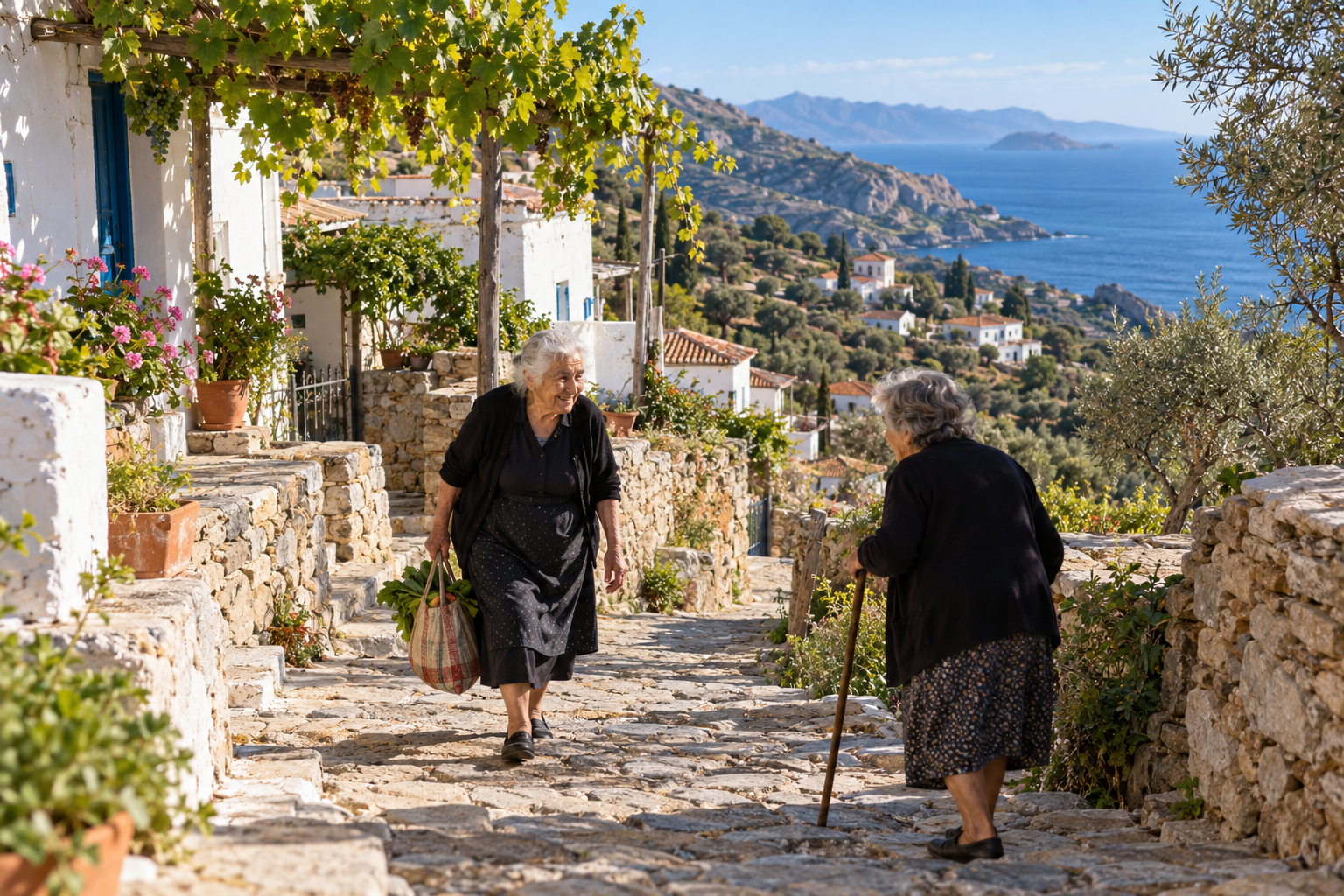
The sixth habit is movement, but not the kind that involves a gym or a plan. The grandmothers of Ikaria do not exercise in any deliberate sense, and you will not find them on treadmills, yet they move constantly, because their daily life is built on physical activity in a way modern life is not. They walk the island’s steep and rugged terrain to visit people and reach their gardens, they tend those gardens and their animals, they carry things up and down hills, and this natural, low-level movement fills their days without ever being thought of as fitness.
This is one of the defining features of every Blue Zone, that the long-lived move naturally and continuously rather than in concentrated bursts of exercise. Walking up a hill to a friend’s house, working a vegetable plot, kneading bread by hand, sweeping a yard, all of it adds up to a body kept in constant gentle use, decade after decade, which appears to serve people far better than sitting all day and then punishing themselves at the gym. The Ikarian terrain almost forces this, since little on the island is flat or convenient, and the grandmothers who have walked those hills all their lives arrive in old age with strong hearts and steady legs as a simple byproduct of how they live. Movement, for them, is not something added to the day but woven all through it. There is no boundary in their lives between exercise and everything else, no hour set aside for the body while the rest of the day is spent sitting, and that seamlessness may be the whole secret, since a habit you never have to summon the willpower for is a habit you never quit.
The Web of People Around Them
The seventh and eighth habits are about other people, and they may matter most of all. The seventh is the sheer density of social connection in which the grandmothers live. Study after study of Ikaria’s oldest residents finds that almost all of them have daily contact with family, friends, or neighbors, and virtually none are isolated, a stark contrast to the loneliness that shadows old age in much of the West. They are embedded in a web of people, visited and visiting, folded into family and community life right to the end rather than set aside. An old woman on Ikaria is not a person the world has finished with but a grandmother, a neighbor, a fixture of the daily round, and that continued place in the lives of others is something modern societies, for all their wealth, routinely fail to give their elderly.
The eighth habit runs alongside it: a life of faith, festival, and belonging. The great majority of Ikaria’s elderly are religious, taking part in the rhythms of the Orthodox church, including its regular fasts, which impose a natural periodic restraint on the diet, and joining the island’s many communal festivals, the panigiria, that gather the whole community in celebration. Whatever one makes of the faith itself, the structure it provides, regular gathering, shared meaning, a calendar of communal events, and a place in something larger than oneself, is exactly the kind of thing that sustains people. Loneliness is now understood to be as harmful to health as many physical risk factors, and the grandmothers of Ikaria are perhaps as protected against it as anyone on earth, held all their lives inside a community that never lets them drift to its edges.
The Unhurried Mind
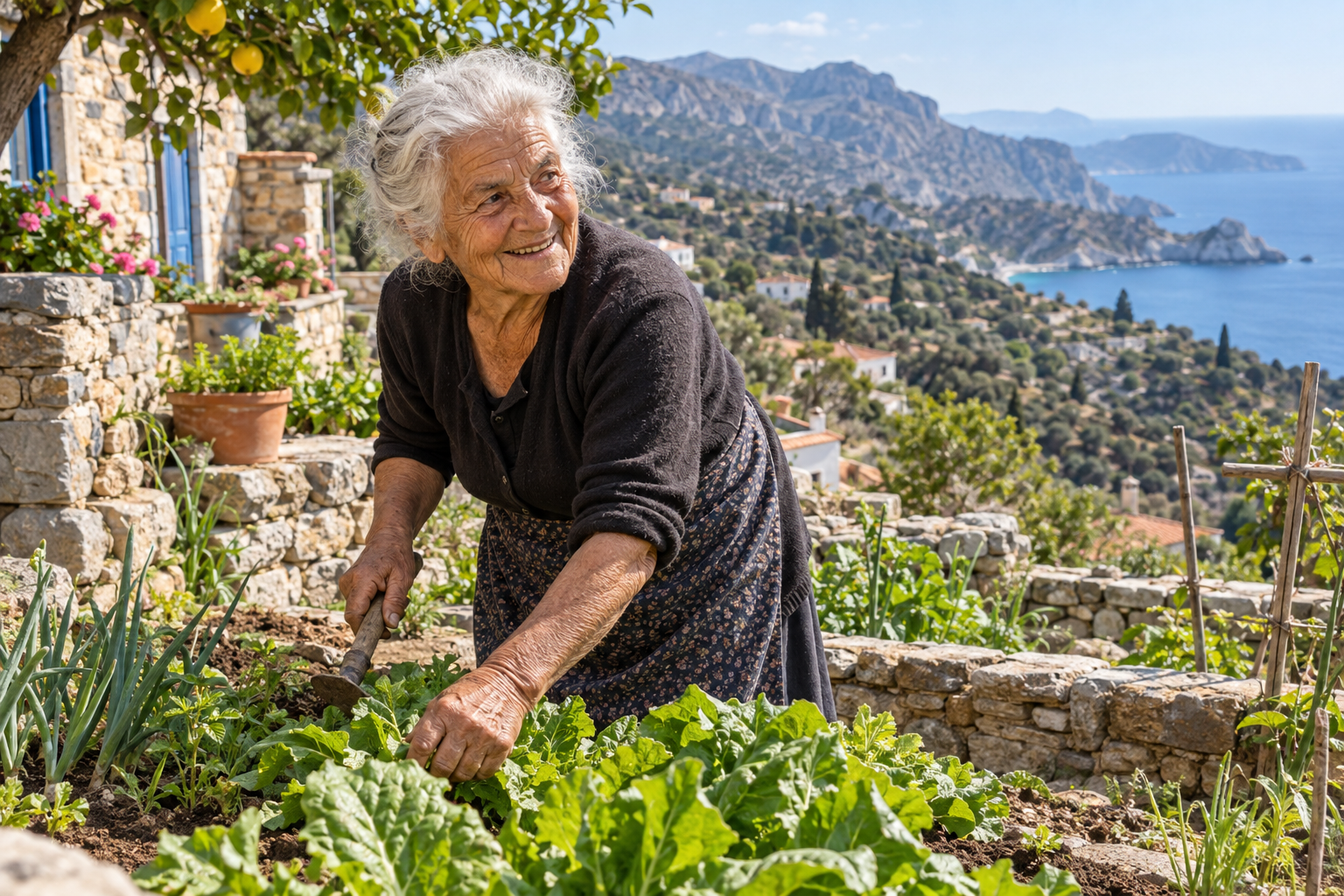
The ninth habit is the hardest to bottle but may underlie all the rest: a relaxed, unhurried relationship with time. On Ikaria, life simply moves slowly, without the frantic pace and clock-watching that define modern existence. There is a local joke that nobody knows what time it is, and appointments happen when they happen, meals are never rushed, and the day unfolds at the speed of the people living it rather than the demands of a schedule. This is not laziness but a different and protective way of being, one that keeps the corrosive chronic stress of modern life largely at bay.
Researchers increasingly believe this low-stress rhythm is one of the most powerful ingredients in the Ikarian recipe, since chronic stress drives so much of the inflammation and illness that shortens lives elsewhere. Bound up with it is a ninth-and-a-half habit worth mentioning, the moderate daily glass of wine taken with food and company, another small, social, unhurried pleasure rather than a solitary indulgence. The grandmothers of Ikaria are not straining to live long or optimizing their health in any conscious way, and that absence of striving is itself part of the point, a life arranged, almost accidentally, around the very things that turn out to sustain it. They are simply living the way the island has always lived, slowly, sociably, and close to the land, and the long life simply follows, almost as an afterthought. That may be the most humbling finding of all for a world obsessed with optimizing everything, that the people who live longest are the ones trying least hard to, going about ordinary days that happen to contain, without design, nearly everything the science says we need.
The Honest Caveat
Before anyone treats this as a formula, it is worth being clear-eyed about what the research actually supports, because the honest version is more useful than the hype. The most important thing to understand is that no single one of these habits is a magic key, and researchers are emphatic that Ikarian longevity comes from the cumulative, reinforcing effect of all of them together, woven into a whole way of life over decades, not from any one trick you can lift out and bolt onto an otherwise modern existence. Drinking herbal tea while sitting alone in a stressful city is not the same as being a lifelong Ikarian, and the habits work as a system, not a checklist. Pull one thread out of the weave and it loses much of its power, which is why the wellness industry’s habit of isolating and selling single Blue Zone tricks tends to disappoint.
It is also worth knowing that the picture is not one of magically disease-free superhumans, whatever the glossier headlines suggest. The oldest Ikarians studied still had plenty of ordinary ailments, high blood pressure and the rest, so the island’s gift is long, functional, connected life rather than perfect health, and even the celebrated diet showed only moderate adherence in some studies. None of this means the habits are worthless, far from it, since each one, the plants and greens, the movement, the naps, the deep social ties, the low stress, is independently supported by broader research as good for healthy aging, and adopting any one of them is likely to do you some real good, even if you cannot recreate the whole island in your own life. The honest takeaway is simply this: there is no supplement to buy and no shortcut to copy, only a way of living, plant-fed, well-rested, physically active, deeply connected, and unhurried, that the grandmothers of Ikaria happen to embody and that the rest of us can move toward in our own lives by degrees. This is general information rather than medical advice, and no set of habits guarantees a long life, but few things are as well worth borrowing as the daily rhythms of the place where people forget to die.

About the Author: Ruben, co-founder of Gamintraveler.com since 2014, is a seasoned traveler from Spain who has explored over 100 countries since 2009. Known for his extensive travel adventures across South America, Europe, the US, Australia, New Zealand, Asia, and Africa, Ruben combines his passion for adventurous yet sustainable living with his love for cycling, highlighted by his remarkable 5-month bicycle journey from Spain to Norway. He currently resides in Spain, where he continues sharing his travel experiences with his partner, Rachel, and their son, Han.