
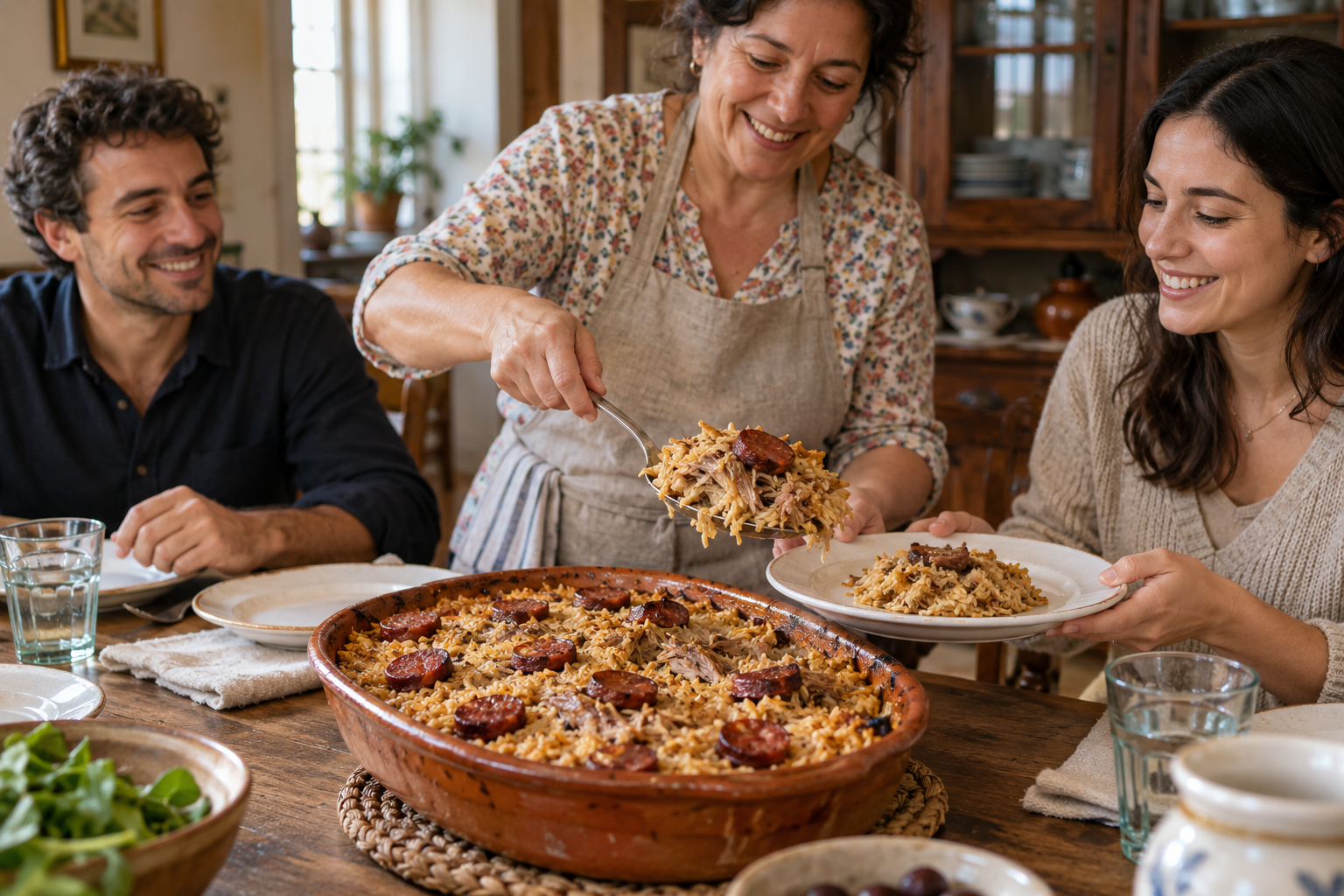
Some dishes are weeknight quick and some are Sunday slow, and arroz de pato belongs firmly to the second kind, the sort of thing a Portuguese family makes when there is real time to do it properly and people worth doing it for. This is Portugal’s duck rice, a rich, deeply savory baked rice built on shredded duck, smoky chourico, and a broth made from the bird itself, finished with a crisp golden top and a squeeze of fresh orange. It is not a fast dish, and anyone promising you a fifteen-minute version is selling you something else entirely, because the whole point of arroz de pato is the patient layering of deep flavor that only real time can build. But the reward is one of the great comfort dishes of Europe, and a single hot forkful straight from the oven tells you exactly why generations of Portuguese cooks have thought it worth every minute of the wait. The smoky rice, the tender duck, the crisp browned top, and the bright hit of orange arrive together in a way that no quicker dish ever quite matches.
What follows is where this Sunday dish comes from, why the broth is its soul, why it takes the time it does, the crisp top and bright orange that finish it, and exactly how to make it.
A Northern Sunday Dish
Arroz de pato has its heart in the north of Portugal, in and around the historic city of Braga, where the cold, wet winters have long made slow-baked rice and hearty stews the natural, warming food of the cold season. It is comfort food in the very truest sense, born of a climate that rewards a warm oven and a long afternoon in the kitchen, and it has spread from those northern roots to become one of the most beloved dishes in all of Portugal, as likely to appear on a good restaurant menu as at a Sunday family table. When a Portuguese cook wants to feed people well and show a little love in the doing, this is very often what they make.
It carries the particular status of a Sunday or celebration dish, the kind reserved for when the family gathers and there is reason to make an effort. Rice might not be the first thing an outsider associates with Portuguese cooking, but the country has a long love affair with it, dating back over a thousand years to the Moorish period, and arroz de pato is that tradition at its most ambitious. Portugal has a whole family of beloved rice dishes, from soupy to baked, and this duck version sits proudly at the top of the range. It is not everyday food, and it is not meant to be, and that is part of its appeal, since a dish that takes real time to make becomes an event in itself, the slow cooking as much a part of the Sunday as the eating itself. To make it is to keep a small piece of Portuguese family ritual alive, and to understand why some food is worth slowing down for. In a world of fast everything, a dish that insists on its own unhurried pace is a small act of resistance, and a delicious one.
It’s All in the Broth
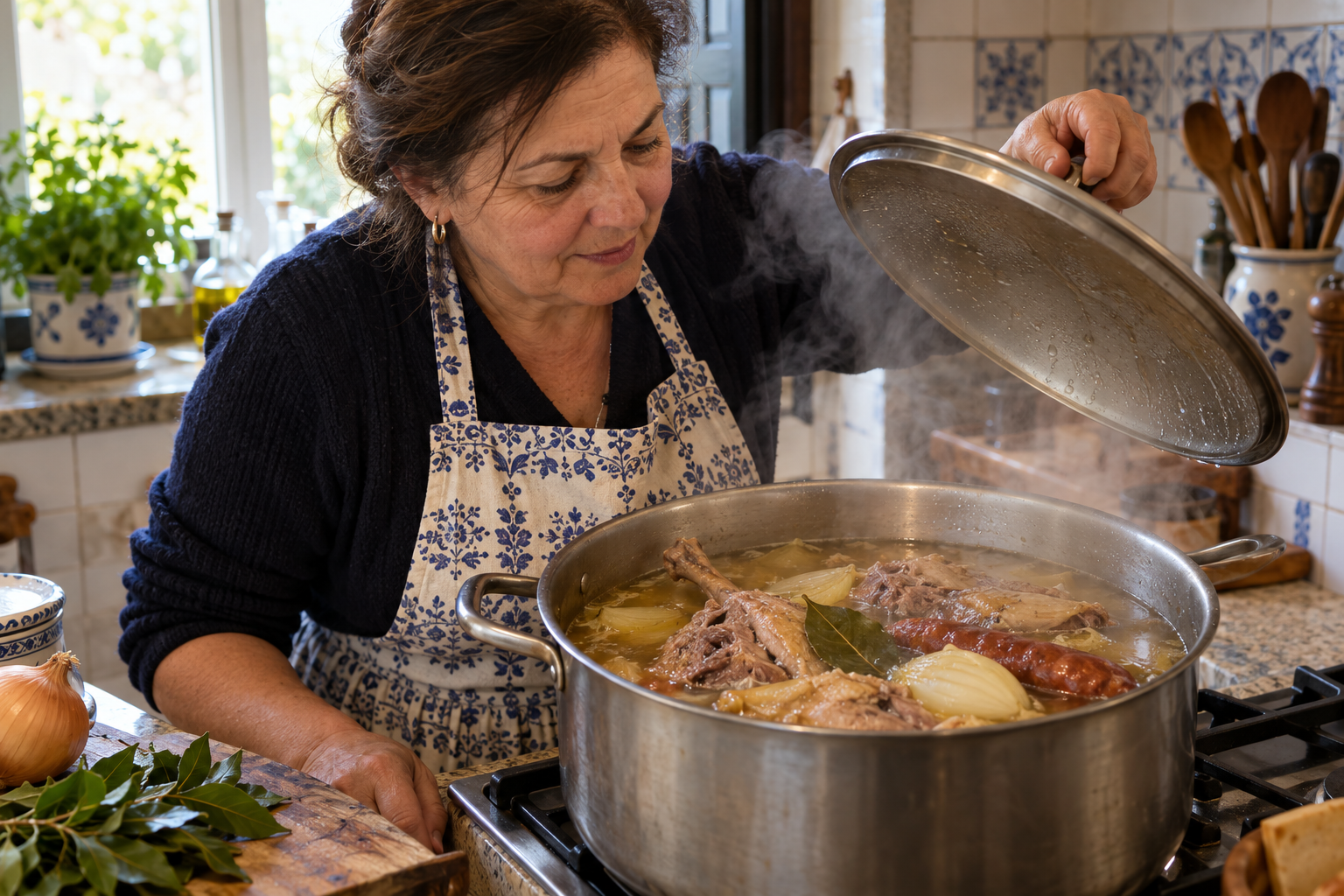
Ask any traditional Portuguese cook the secret to a great arroz de pato and the answer comes back the same every time: it is all in the broth. The dish begins not with the rice but with a whole duck, simmered slowly in a big pot of water along with smoky chourico, a chunk of cured bacon, onion, garlic, carrot, leek, bay leaves, and a few whole cloves and peppercorns, until the duck is tender and the water has become something else entirely, a deep, rich, savory stock carrying the flavor of everything that cooked in it. That broth is the soul of the whole dish, and its quality decides whether the finished rice is merely good or genuinely memorable.
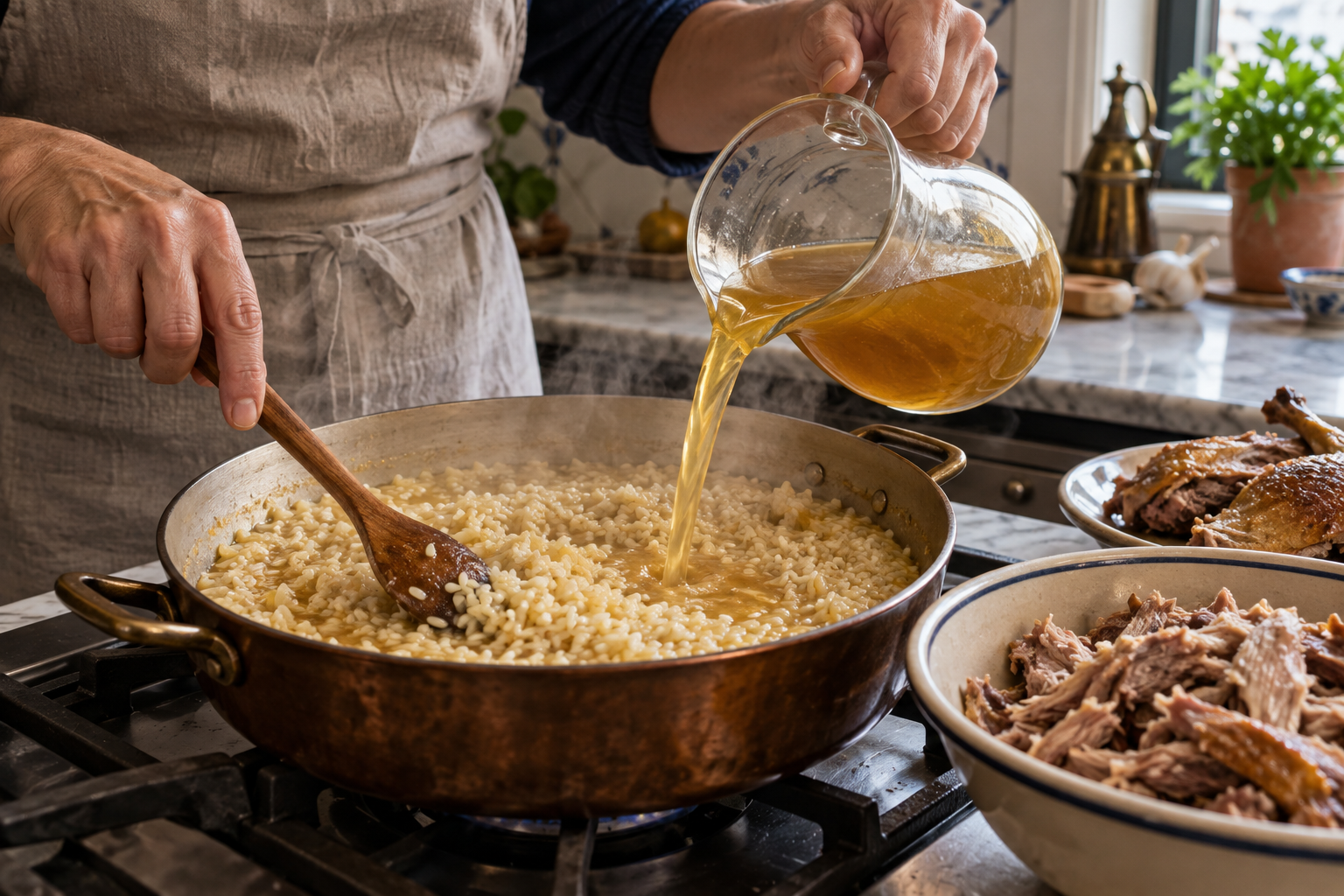
The reason this matters so much is that the rice is then cooked in that duck broth rather than in plain water, so every grain drinks up the concentrated flavor of the bird and the smoky sausage and the aromatics. This is the trick that gives arroz de pato its extraordinary depth, the rice arriving at the table tasting profoundly of duck itself rather than merely sitting alongside it, and it is why the long simmering that makes the broth can never be skipped. Nothing you add later can replace a broth that was rushed or thin, so the patience all goes in at the very start, in that unhurried pot simmering on the stove, and everything good about the finished dish flows directly from it. Get the broth right, deep and glossy and full of flavor, and you have already made a great arroz de pato before the rice even goes in. Everything that follows is really just carrying that broth’s flavor into the rice and giving it a crisp finish, so the effort you put into the pot at the start pays off in every grain at the end.
Why It’s Worth the Wait
There is no pretending this is a quick dish, and it helps to understand its three unhurried stages so the time feels purposeful rather than daunting. First comes the broth, the long simmer of the duck and its companions that builds the flavor base. Then comes the shredding, the patient work of pulling all the tender meat off the cooked duck and setting it aside, discarding the bones. And finally the rice is cooked in the strained broth and combined with the duck before the whole thing is baked. It is genuine work, spread across a couple of hours, and it dirties a good few pots, and it is completely worth it.
The good news is that the labor can be tamed by splitting it across two days, which is how many Portuguese cooks handle it and how it becomes far less of an ordeal. You can make the broth and shred the duck a day ahead, letting the broth chill overnight so the fat rises and can be skimmed off easily, and then simply cook the rice and assemble and bake on the day you want to eat, which turns what sounds like a daunting all-day project into a relaxed hour of finishing on the day itself. However you time it, the reward justifies the effort completely, because this is not a dish you make often but one you make when it matters, and the sheer depth of flavor that all that patience produces is something no shortcut can ever imitate. The wait is not a flaw in the recipe but the entire source of its greatness. Rush it and you get a passable duck-flavored rice; give it the hours it asks for and you get one of the most satisfying dishes Portugal has to offer, which is a trade any cook who loves the process will happily make.
The Crispy Top and the Orange
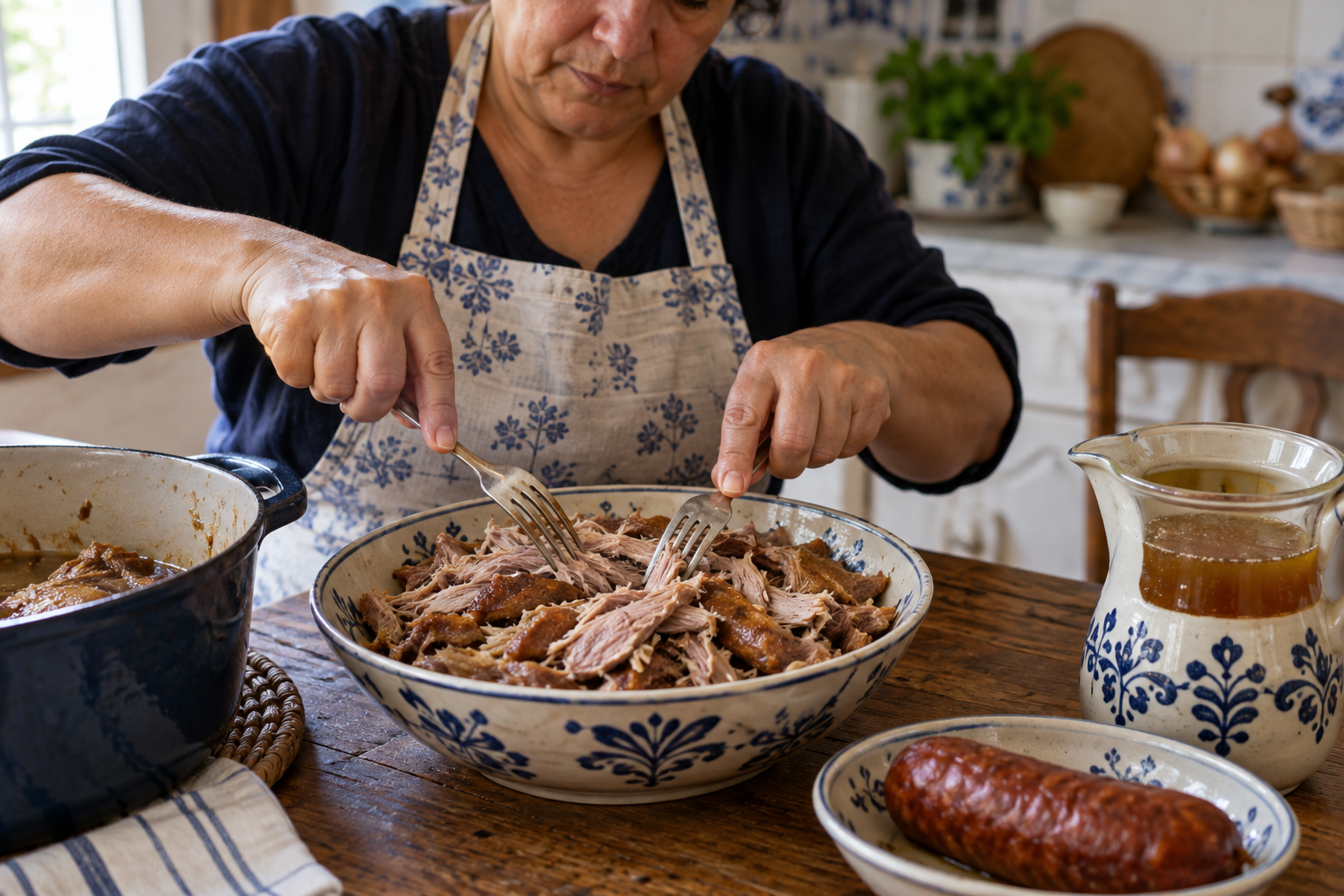
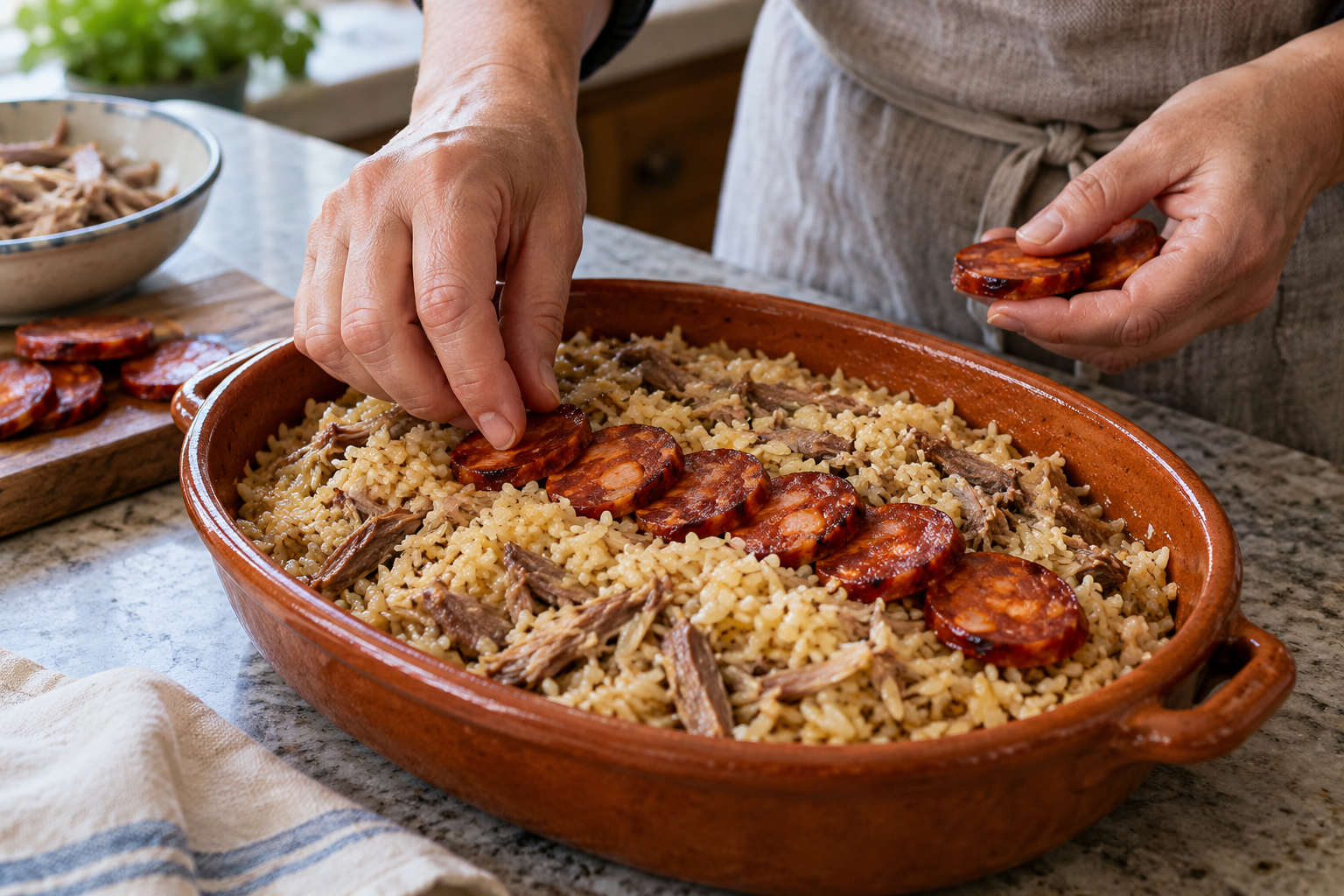
The final stage is where arroz de pato becomes unmistakably itself, and it turns on two finishing touches worth getting right. Once the flavored rice is mixed with the shredded duck, the whole lot goes into a baking dish, traditionally a Portuguese clay one, and is topped with slices of the cooked chourico laid out across the surface. Then it bakes in a hot oven until the top turns golden and crisp and the fat from the chourico renders down into the rice below, threading smoky richness through every bite. That crisp, browned top against the soft savory rice beneath is the textural heart of the dish, so do not pull it from the oven too soon, since the crust is half the pleasure. The best bit, ask any Portuguese eater, is the slightly crunchy rice at the edges where it met the hot dish, so a good long bake is never wasted.
The second finishing touch is the one that lifts the whole dish from heavy to balanced, and it surprises people who have not met it before: fresh orange. Arroz de pato is traditionally served with slices of orange or a squeeze of its juice over the top, and that bright citrus cutting through the smoky, fatty richness of the duck and sausage is the detail that makes the dish sing rather than sit heavy. It is a genuinely inspired pairing, the sweetness and acidity of the orange harmonizing with the deep savory rice in a way you would not predict but never forget, and it is as traditional and essential as the chourico on top. Portugal is a country of oranges as well as ducks, and the two meet on this plate as if they were always meant to. Skip the orange and you have a fine baked rice; include it and you have the real thing.
Making Arroz de Pato
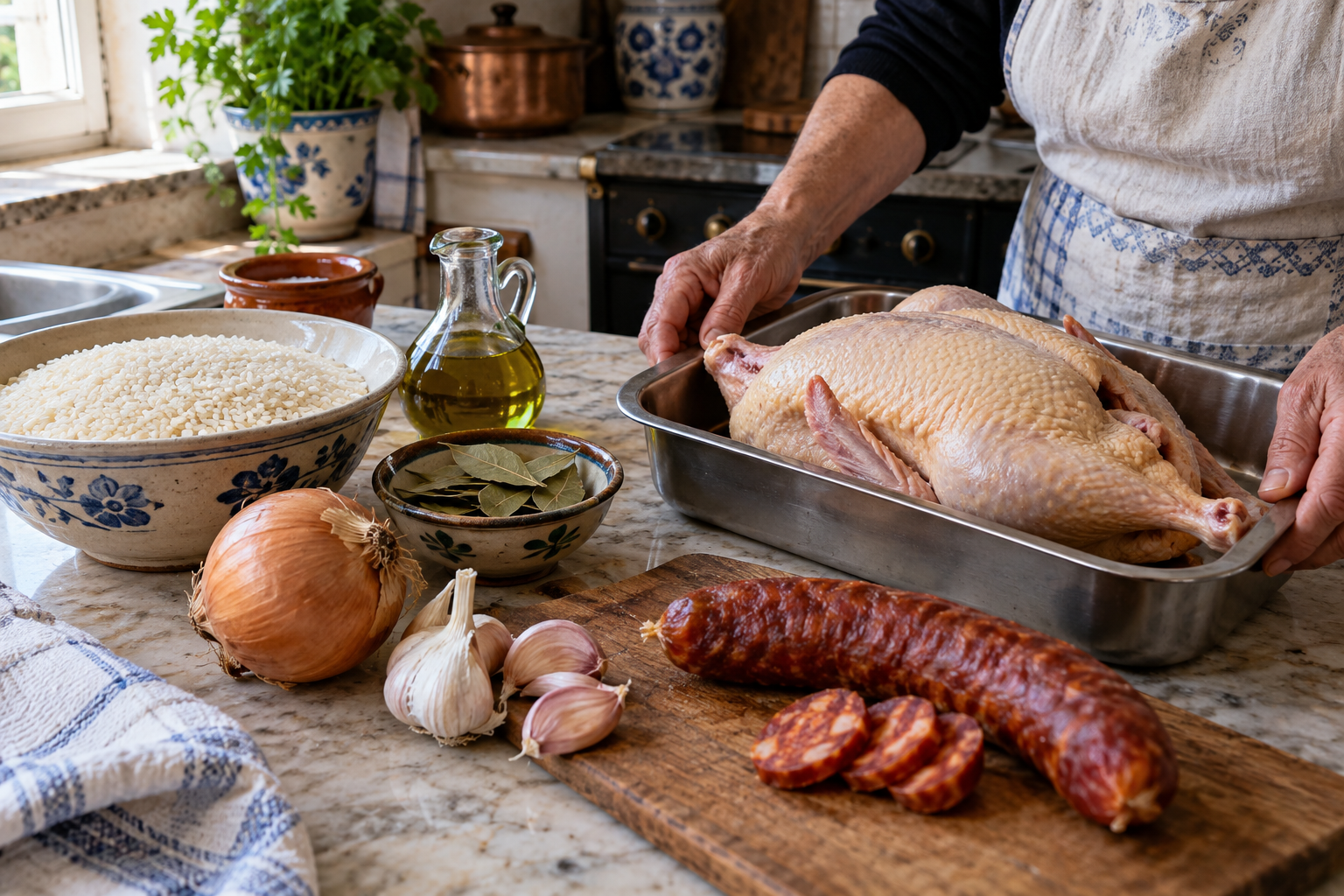
Here is a classic arroz de pato, serving six. It takes time, so make the broth and shred the duck ahead if you can, and do not skip the orange.
Ingredients
- 1 whole duck, about 2 kg, cut into pieces, or 6 duck legs
- 2 smoked chourico sausages
- 150 g cured bacon or pancetta, in one piece
- 1 onion, plus 1 more for the broth
- 3 cloves garlic
- 2 carrots
- 1 leek
- 2 bay leaves, a few cloves, and black peppercorns
- 2 oranges
- 400 g short-grain rice, such as Carolino, or another absorbent rice
- Salt, to taste
- Chopped parsley, to serve
Instructions
- Make the broth: in a large pot, cover the duck, chourico, bacon, one whole onion, garlic, carrots, leek, bay, cloves, and peppercorns with water. Bring to a boil, skim the foam, then simmer gently for about 45 to 50 minutes, until the duck is tender.
- Remove the duck, chourico, and bacon and set aside. Strain the broth and reserve it. Skim off excess fat, ideally after chilling.
- When cool enough to handle, shred all the duck meat off the bones and discard the bones. Slice the chourico into rounds and dice the bacon.
- Cook the rice: in a pot, bring about 900 ml of the strained duck broth to a boil, add the rice, cover, and simmer for 8 to 10 minutes until the broth is nearly absorbed and the rice is just al dente.
- Stir the shredded duck, the diced bacon, and half the chourico slices through the rice, seasoning with salt to taste.
- Transfer to a baking dish, smooth the top, and arrange the remaining chourico slices over the surface. Bake at 200 C, about 400 F, for 15 to 20 minutes, until the top is golden and crisp.
- Scatter with parsley and serve hot, with orange slices alongside and a squeeze of orange juice over the top.
And do treat the broth and the orange as non-negotiable, since they are what separate a true arroz de pato from an ordinary baked rice, so give the broth its time and never send the dish to the table without the bright lift of the orange that Portugal always serves alongside it.

About the Author: Ruben, co-founder of Gamintraveler.com since 2014, is a seasoned traveler from Spain who has explored over 100 countries since 2009. Known for his extensive travel adventures across South America, Europe, the US, Australia, New Zealand, Asia, and Africa, Ruben combines his passion for adventurous yet sustainable living with his love for cycling, highlighted by his remarkable 5-month bicycle journey from Spain to Norway. He currently resides in Spain, where he continues sharing his travel experiences with his partner, Rachel, and their son, Han.