
Walk into a German kitchen in the middle of November and you may find something strange sitting in a cool pantry or wrapped in foil at the back of a cupboard. It is a heavy loaf that nobody is allowed to touch, pale gold under a thick white coat of sugar, dense with fruit and almonds. It is doing nothing at all except waiting.
This is Stollen, the German Christmas bread, and the thing that makes it different from almost every other baked good you know is that it is not meant to be eaten fresh. It is baked now, in the weeks before Advent, and then it is left to age until Christmas, getting better the longer it sits. If you want one on your table this December, the clock is already running, which is exactly why Germans are baking theirs this week.
Here is what Stollen actually is, why it is deliberately made weeks ahead, the ripening that turns a dry loaf into something wonderful, and how to make your own in time. It is one of the few bakes in the world where patience is not a virtue but a technique, and once you understand why, the whole strange ritual makes perfect sense. For anyone spending a first Christmas in Europe, it is also one of the loveliest ways to feel the season start early, weeks before the markets open and the lights go up.
The Loaf Shaped Like a Swaddled Child
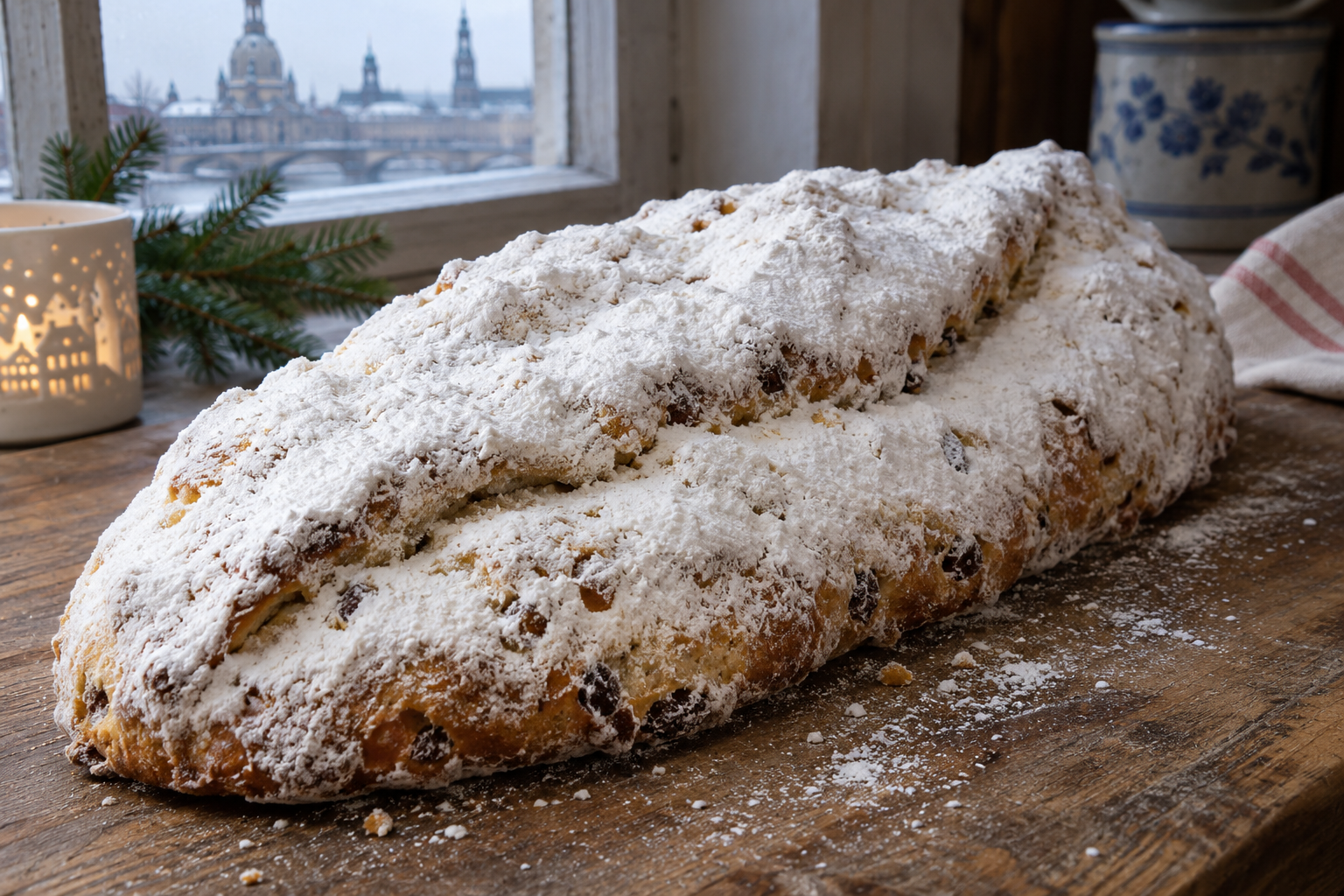
Stollen is a rich, dense, fruit-studded bread, somewhere between a bread and a cake, heavy in the hand and built to last. The classic version, the one with the most history behind it, is Dresdner Stollen, from the city of Dresden in Saxony, where it has been made for more than five hundred years. The name is now protected, so that only loaves baked in the Dresden area by approved bakers can carry it.
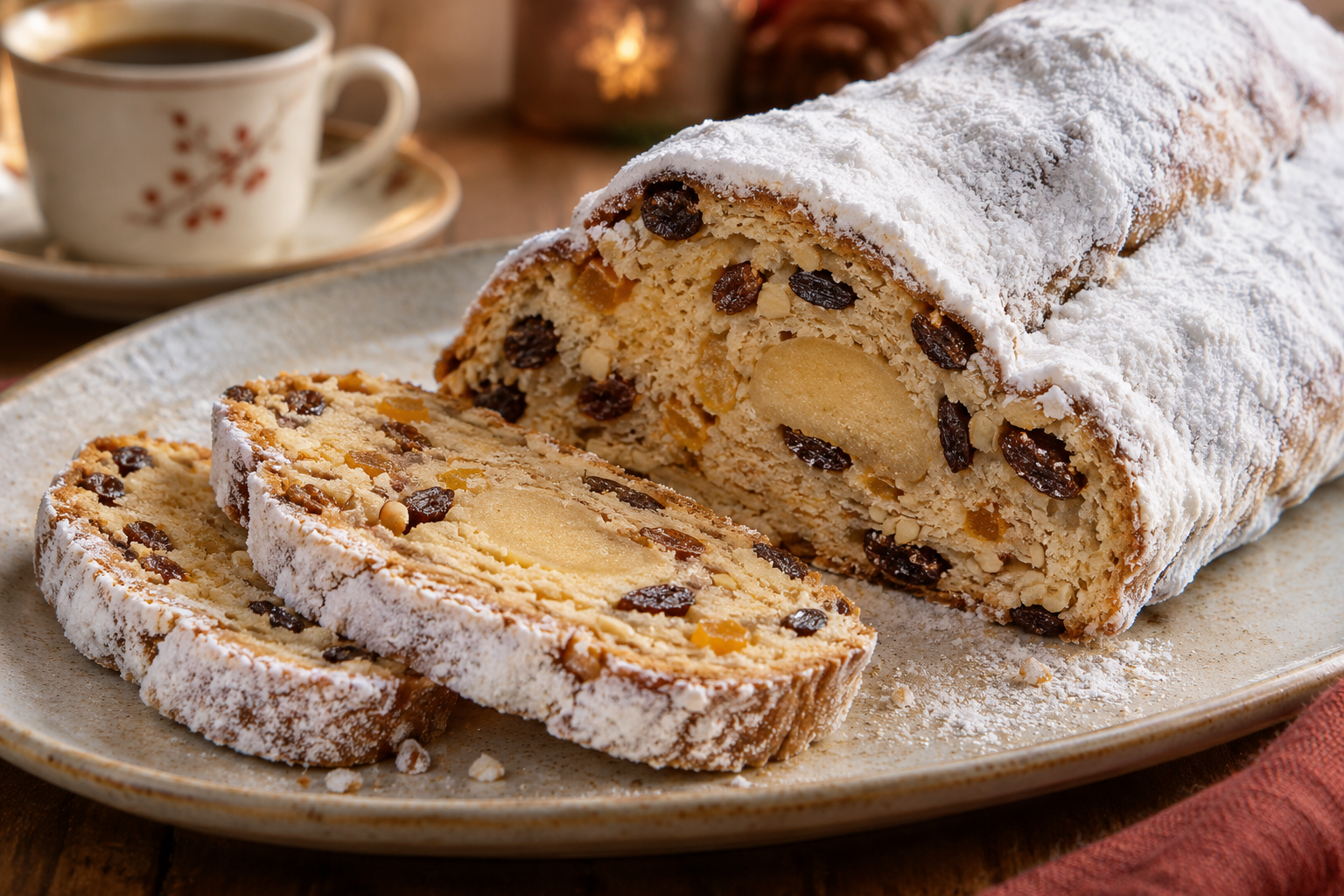
A proper Stollen is packed with raisins and other dried fruit soaked in rum, with candied citrus peel, with almonds, and often with a core of marzipan running down the middle. The whole thing is coated after baking in melted butter and a thick, almost snowdrift layer of icing sugar. It is a loaf that looks like winter before you have even cut it.
That shape and that sugar are not decoration for their own sake. The loaf is traditionally folded over on itself into a long, rounded form with a ridge down the top, and the old story says it is meant to represent the Christ child wrapped in swaddling clothes, the pale sugar standing in for the blanket. Whether or not you take the religious meaning, the form is practical too. The dense fold and the butter-and-sugar crust seal the loaf and help it keep for weeks without drying to dust, so everything about a Stollen is built around the fact that it is supposed to sit and wait.
Why Germans Bake It Weeks Before Christmas
Here is the part that confuses nearly every American baker who meets Stollen for the first time. You do not make it the day before you want to eat it. You make it in the second half of November, sometimes even earlier, and then you put it away.
A Stollen baked today, in the middle of November, is being made at exactly the right moment to be ready by Christmas. A German baking one this week is not ahead of schedule but right on time. The reason is ripening, the same principle behind a good fruitcake or a Christmas pudding.
A freshly baked Stollen is honestly a little disappointing, somewhat dry and a bit flat in flavor, the rum and spices sitting separate and sharp. But sealed in its butter and sugar and left somewhere cool for two, three, even four weeks, it undergoes a slow transformation. The moisture from the soaked fruit migrates evenly through the crumb, the butter settles in, the rum mellows, and the spices marry into a single deep, rounded, Christmassy flavor that a fresh loaf simply cannot have. The waiting is not storage, it is part of the cooking, and the loaf does its most important work after it leaves the oven.
This is why the timing matters so much and why it genuinely starts now. If you want a well-ripened Stollen for Christmas, you need to bake it roughly three to four weeks ahead, which puts the ideal baking window in the back half of November, right where the calendar sits this week.
Leave it until the week before Christmas and you will have a Stollen, but you will miss most of what makes the thing special. The Germans are not being quaint when they bake early. They are respecting a loaf that refuses to be rushed.
What Americans Get Wrong About It
The instinct that trips up American bakers is the one that serves them well with almost everything else, which is that fresh is best. We are trained to pull bread warm from the oven, to time a cake so it is still faintly steaming when it reaches the table, to treat anything more than a day old as past its prime. Stollen quietly overturns all of that.
A Stollen eaten the day it is baked is the one you should feel a little let down by, because it has not done its ripening yet. The loaf you want is the one that has sat forgotten in a cool cupboard for the better part of a month, growing denser and more fragrant while you were not looking.
Treating Stollen like fresh bread is the single most common mistake, and it is the reason a first attempt made on Christmas Eve so often disappoints. The fix is not a better recipe. It is a calendar, and the willingness to bake in November for a reward you will not taste until late December. Once you have made peace with that, the loaf becomes one of the easiest Christmas bakes there is, precisely because all the hard part is simply leaving it alone.
A Little History, Because It Explains the Butter
Stollen started out as a far plainer and frankly worse thing than what you eat today. In the medieval church, Advent was a fast, and the rules forbade butter, so the earliest Stollen were made with oil and were dense, dull, and not much of a treat. The story goes that a Saxon prince and his brother petitioned the Pope for permission to use butter, and the resulting Butterbrief, the butter letter, eventually freed Dresden’s bakers to make the rich, buttery loaf that became famous.
It is a small, almost comic piece of history, a papal dispensation about baking fat, but it is the hinge on which the whole modern Stollen turns. Once butter was allowed, the loaf became the lavish, keeping-rich thing it is now, and Dresden built a tradition around it that survives in full force today. The city holds a Stollenfest each December, parading a single giant Stollen weighing several tons through the streets before it is cut and sold, a festival that goes back to the eighteenth century.
All of that pageantry grew out of one simple fact, that a well-made, butter-rich, well-aged Stollen is one of the great keeping cakes of Europe. It is a loaf you make once and eat slowly across the whole of the Christmas season, cutting a slice at a time as the weeks go by. That slow eating is part of the pleasure, because a Stollen is not a thing you devour in a sitting.
You keep it wrapped, you cut a slice with afternoon coffee, you watch it last from the first Sunday of Advent nearly to the New Year, and it tastes a little different, a little deeper, each week. For a household that has moved to Europe or is spending its first Christmas abroad, learning to bake one in November and dole it out through December is one of the most satisfying small rituals the season offers. It is the opposite of the last-minute Christmas scramble, a thing you did weeks ago that keeps on giving.
The Timing Rule, Made Simple
If you take nothing else from all of this, take the rule, because it is the whole game. Bake your Stollen about three to four weeks before Christmas, then wrap it well and let it rest somewhere cool. That is it. In practice, for a Christmas loaf, that means baking in the second half of November, which is why this week is the moment it all begins.
The storage is simple but it matters. Once the loaf is baked, still warm, you brush or soak it generously in melted butter and roll it thickly in icing sugar, then let it cool completely.
You wrap it tightly, first in parchment or foil and then in a bag or an airtight tin, and you keep it somewhere cool and dark, a cold pantry, a garage, a cellar, anywhere that stays reliably cool but not freezing. Then you leave it alone. Some bakers give it a second coat of sugar after a week, but most simply wait, and the loaf rewards them for it.
Make It: Dresden-Style Stollen
This makes one large loaf, enough to see a household through the Christmas weeks a slice at a time. Start it now, in the back half of November, so it has three to four weeks to ripen before Christmas. The dough is enriched and slow, so give yourself an unhurried afternoon.
Ingredients
For the fruit, soaked ahead:
- 250g raisins
- 100g mixed candied citrus peel, chopped
- 50ml dark rum
For the dough:
- 500g strong white bread flour
- 7g instant yeast (one sachet)
- 75g sugar
- 200ml whole milk, warmed
- 150g butter, soft
- 1 egg
- a good pinch of salt
- zest of 1 lemon
- 1 teaspoon ground cardamom
- half a teaspoon ground cinnamon
- quarter teaspoon ground nutmeg
- 100g whole blanched almonds, roughly chopped
- 200g marzipan (optional, for the classic center)
To finish:
- 100g butter, melted
- 100g icing sugar, plus more for a second coat
Instructions
The night before, or at least a few hours ahead, put the raisins and candied peel in a bowl, pour over the rum, stir, and leave them to soak and plump up. This soaking is what keeps the finished loaf moist through its long rest, so do not skip it.
In a large bowl, combine the flour, yeast, and sugar. Add the warmed milk, the soft butter, and the egg, and mix to a rough dough. Add the salt, lemon zest, cardamom, cinnamon, and nutmeg, then knead on a floured surface for a good ten minutes until the dough is smooth, soft, and elastic. It is a rich dough and will feel heavier than a plain bread dough, which is right.
Cover the bowl and let the dough rise in a warm spot until it has roughly doubled, about one to two hours depending on your kitchen. Then tip it out, press it flat, and work in the soaked fruit along with any remaining rum and the chopped almonds, folding and kneading gently until the fruit is spread evenly through the dough. Do this slowly so you do not tear the dough to pieces.
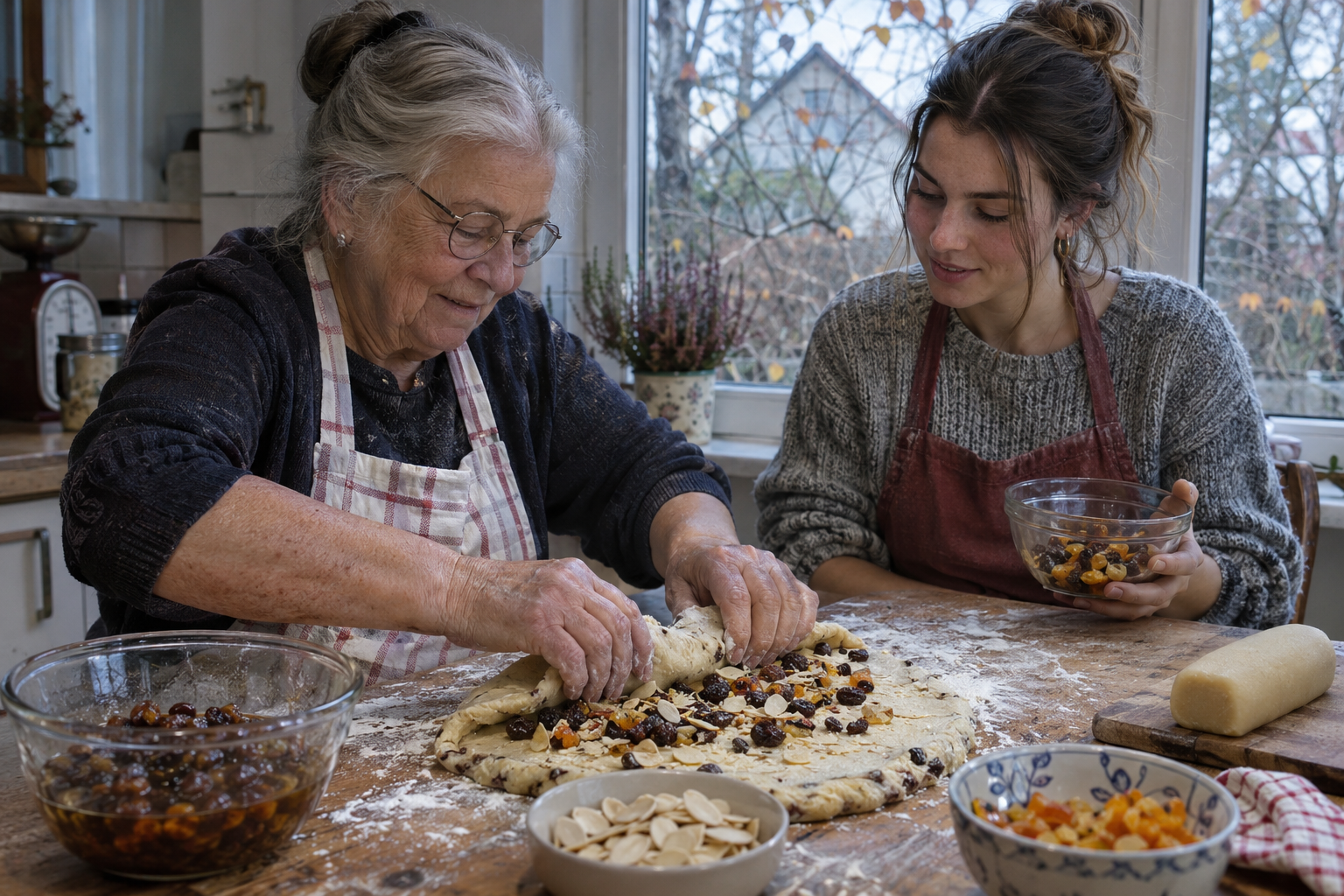
Shape the dough into an oval about the size of a dinner plate. If you are using marzipan, roll it into a log, lay it just off the center, and fold the larger side of the dough over it, pressing lightly so the top edge sits a little short of the bottom one, giving the loaf its classic ridged, folded shape. Place it on a lined baking tray, cover loosely, and let it rise again for about 45 minutes to an hour, until puffy.
Heat the oven to 170 degrees Celsius (340 Fahrenheit). Bake the Stollen for about 45 to 55 minutes, until it is deep golden and sounds hollow when tapped underneath. If the top browns too fast, lay a piece of foil over it. A loaf this dense needs the full time to cook through, so trust the color and the hollow sound rather than rushing it out.
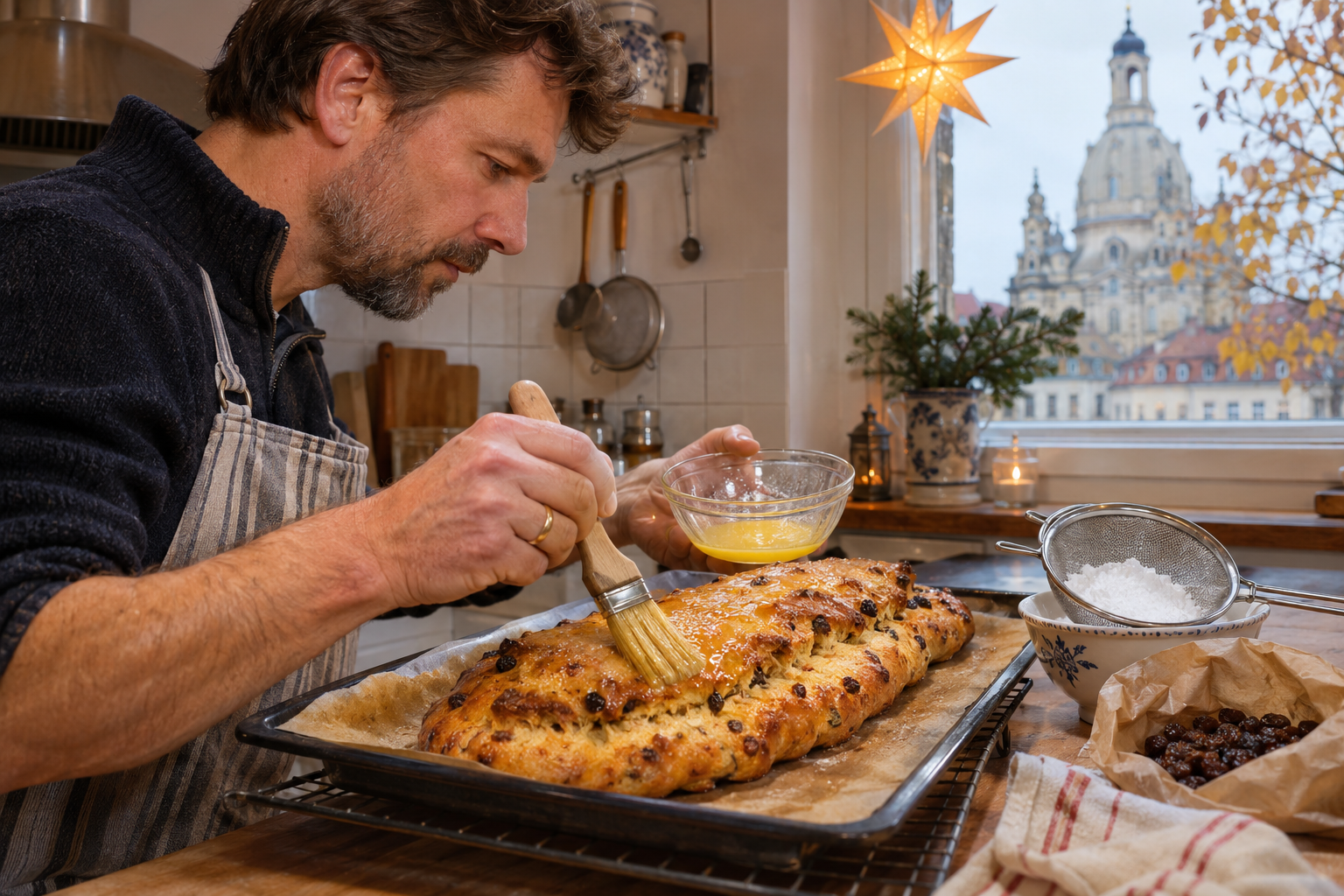
The moment it comes out of the oven, while it is still hot, brush or ladle the melted butter all over it, letting the loaf drink in as much as it will take. Then dust it heavily with icing sugar, turning it so every side is coated in a thick white layer. Let it cool completely.
Now the important part. Wrap the cooled loaf tightly in parchment or foil, then in a bag or tin, and store it somewhere cool and dark. Leave it for at least two weeks, and ideally three to four, before you cut it. After the first week you can give it a fresh dusting of icing sugar if you like. When Christmas comes, unwrap it, cut a slice, and taste what the waiting did. Keep the rest wrapped and cool, and let it carry you through the season a slice at a time.

About the Author: Ruben, co-founder of Gamintraveler.com since 2014, is a seasoned traveler from Spain who has explored over 100 countries since 2009. Known for his extensive travel adventures across South America, Europe, the US, Australia, New Zealand, Asia, and Africa, Ruben combines his passion for adventurous yet sustainable living with his love for cycling, highlighted by his remarkable 5-month bicycle journey from Spain to Norway. He currently resides in Spain, where he continues sharing his travel experiences with his partner, Rachel, and their son, Han.