
Mention the Feast of the Seven Fishes to an American, especially one with Italian roots, and you will likely get a warm, immediate nod. The big Christmas Eve seafood dinner, the seven courses of fish, the fried smelts and the baccala and the linguine with clams, the whole noisy, abundant, fish-laden table, is a cherished tradition in Italian-American households up and down the United States. Mention it to an actual Italian, in Italy, and you are likely to get a blank look.
Because here is the surprising truth: the Feast of the Seven Fishes, by that name and with that number, is not really an Italian tradition at all. It is an Italian-American one.
This catches people off guard, because the dinner feels so deeply, authentically Italian, and in its roots it genuinely is. But the specific thing Americans celebrate, the fixed idea of exactly seven fishes with a proper name attached, is something that took shape among Italian immigrants in America, not in the villages they left behind. Here is what Italians actually do on Christmas Eve, where the real tradition comes from, how the “seven fishes” idea was born in America, why the number is a puzzle even to those who celebrate it, and what this charming mix-up tells us about how traditions travel and change.
What Italians Actually Do on Christmas Eve
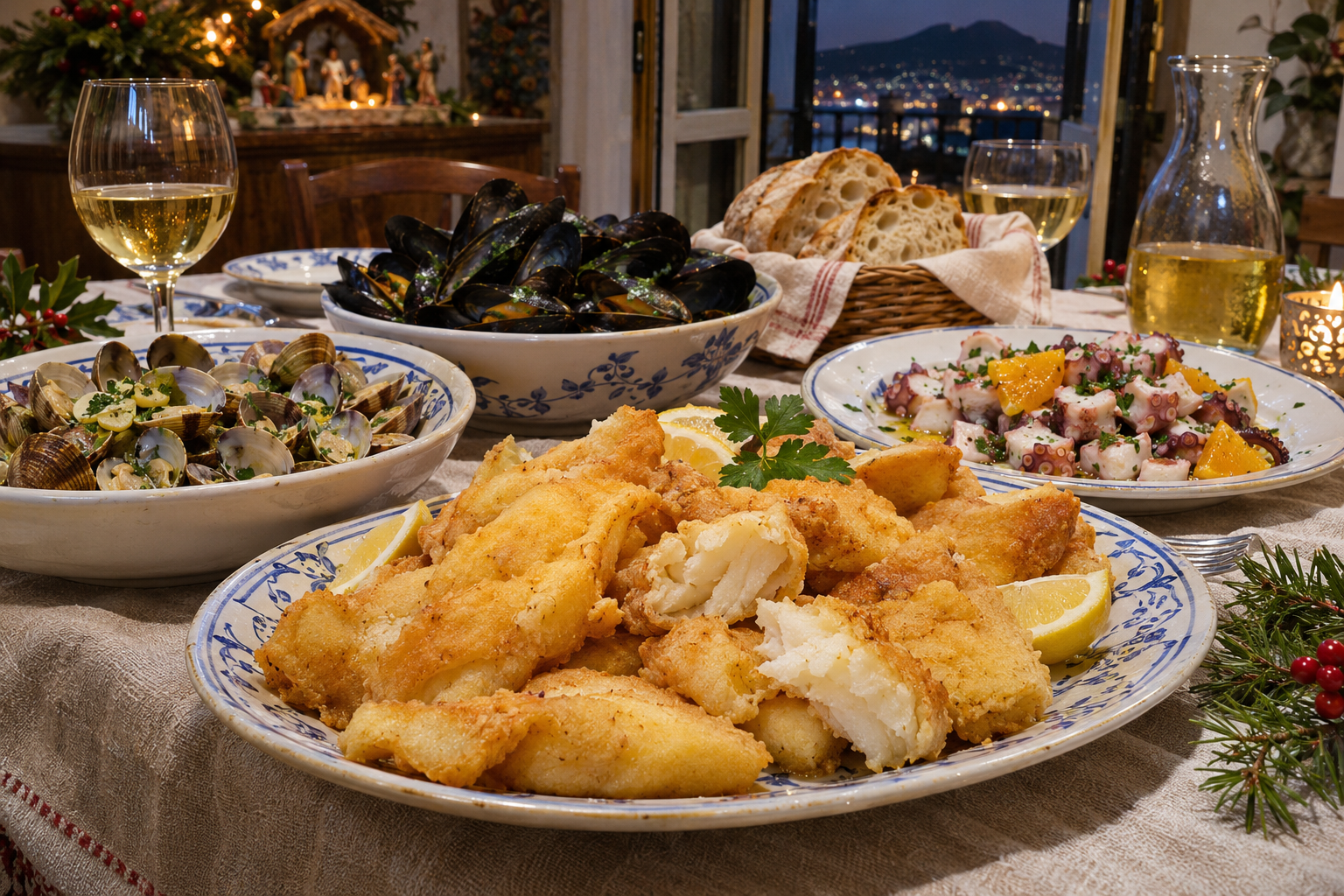
Let us start with what is true, because the confusion grows out of something real. In Italy, Christmas Eve, La Vigilia di Natale, the vigil of Christmas, is traditionally marked by a meal built around fish and seafood rather than meat. This is genuine and widespread, a real Italian custom, and the big Christmas Eve dinner, often called il cenone, the big supper, is indeed commonly a seafood affair.
So the foundation of the American tradition is authentically Italian. Italians really do eat fish on Christmas Eve.
What they do not do is call it the Feast of the Seven Fishes, or fix the number at seven, or treat it as a single codified national tradition with a name. Ask Italians about “the Feast of the Seven Fishes” and most will have never heard the phrase, because it simply is not how the custom is known or discussed in Italy. The meal is just La Vigilia, the Christmas Eve dinner, a fish-based feast whose exact contents vary enormously from region to region, town to town, and family to family. There is no national rulebook, no magic number, no official name beyond the name of the evening itself.
The variety is the key thing to understand. Italy is a country of fiercely regional food traditions, and what appears on a Christmas Eve table in Naples looks quite different from what appears in Venice or Sicily or a landlocked town in the north. Each region leans on its own local fish and its own dishes, and each family has its own version handed down through its own grandmothers. The one shared thread is fish on Christmas Eve, but above that thread, the custom is a sprawling, varied, regional thing, not the single fixed feast the American name implies.
Where the Fish Tradition Comes From
The reason fish anchors the Italian Christmas Eve at all goes back to the Roman Catholic tradition of abstinence. In Catholic practice, certain days, including the eves of major feasts, were days of abstaining from meat, and the night before Christmas was one of them. On such days you did not eat the flesh of warm-blooded animals, so the meal was built instead around fish and seafood, along with vegetables and other permitted foods. The fish on the Christmas Eve table is, at root, the food of a fast day.
This is the genuine, old, religious origin of the whole thing, and it was once common across Catholic Europe, not only in Italy. The idea was that Christmas Eve was a time of waiting and light preparation, a lean vigil before the great feast of Christmas Day itself, when the meat and the full celebration would arrive. So the Christmas Eve fish dinner was originally the restrained, meatless meal of the vigil, with the real feasting reserved for the day that followed. Over time, of course, that “restrained” meatless meal grew in Italian hands into something gloriously abundant, course after course of seafood, but its origin lies in abstinence rather than excess.
It is worth noting that Italy was not alone in this. The same meatless-vigil impulse shaped Christmas Eve across Catholic Europe, from the salt cod of a Portuguese consoada to the twelve meatless dishes of a Polish Wigilia, each country turning the lean vigil into its own tradition. Italy’s fish-based Vigilia is one branch of a much wider European family tree, which is part of why its roots run so deep.
Understanding this religious root helps explain why the custom is so deep and so widespread in Italy while still being so loosely defined. It grew out of a broad Catholic practice observed everywhere, not out of a single regional recipe or a named local festival, which is exactly why it never had one fixed form or one official name. It was simply what observant Catholic families did on the eve of Christmas, each in their own regional and family way, and that organic, unregulated quality is precisely what got lost when the tradition crossed the ocean and acquired a tidy American name.
What Is Actually on the Table
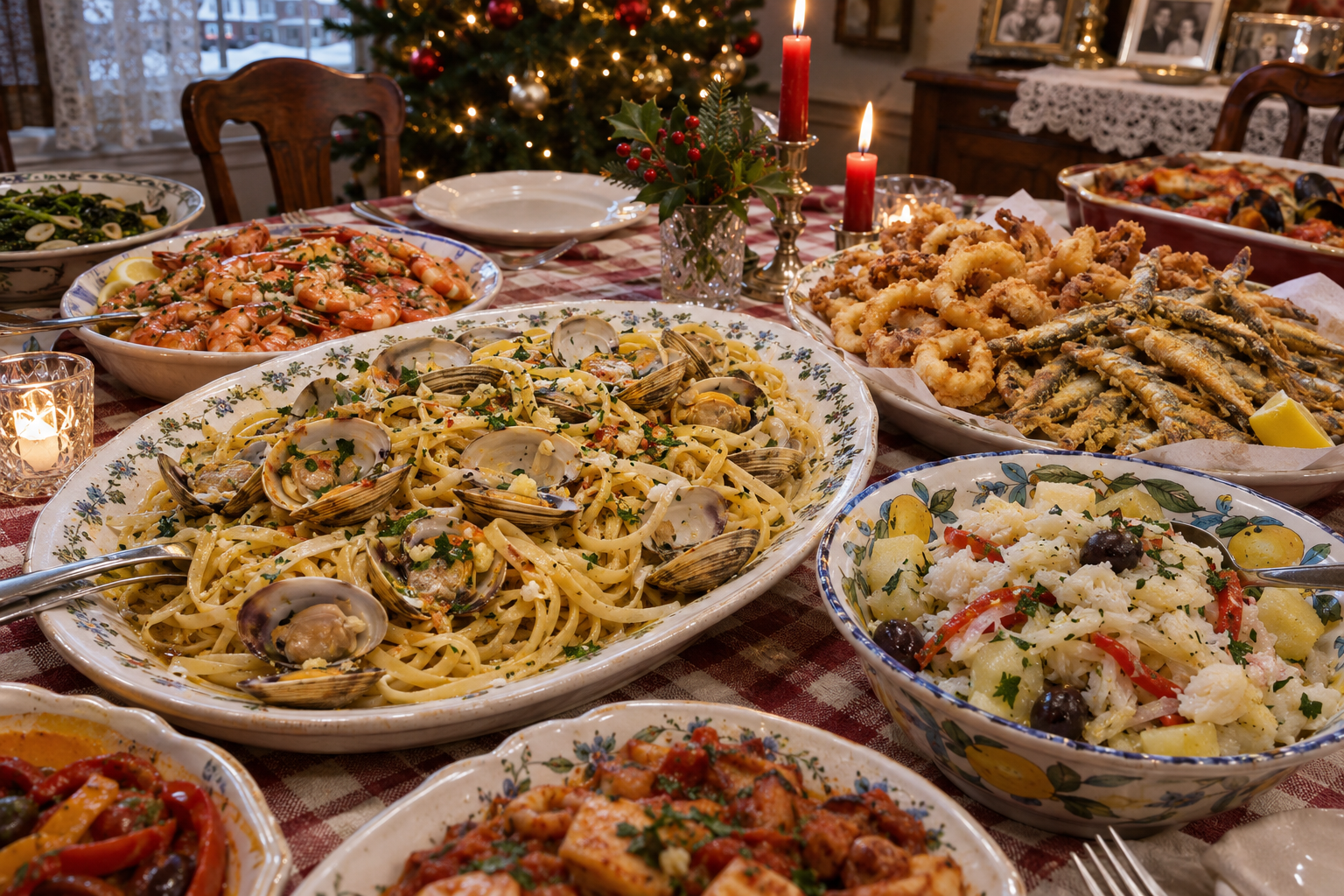
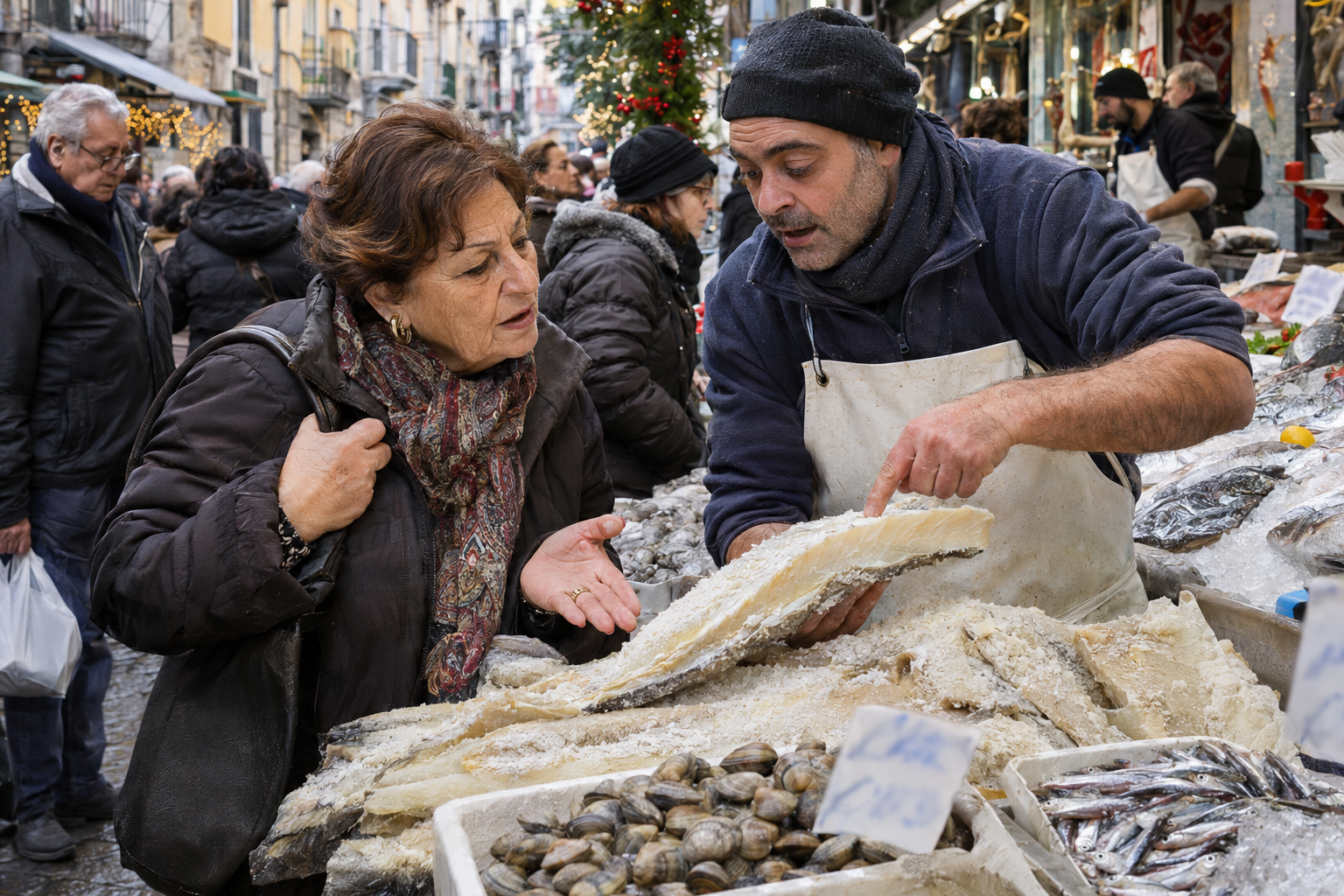
Because the real tradition is so regional, there is no single menu, but the dishes that recur tell you a lot about where the custom comes from and how it varies. The one ingredient that shows up almost everywhere is baccala, salt cod, the preserved fish that fed Catholic Europe through fast days for centuries, served stewed, fried, or in salad depending on the region. If any single food is the backbone of the Italian Christmas Eve, it is salt cod.
Around it, the regional variety blooms. In and around Naples, Christmas Eve might feature capitone, a large eel, long a fixture of the southern Vigilia, alongside fried fish and seafood. Coastal regions lean on whatever their waters give, clams and mussels in a garlicky broth, linguine tangled with vole or clams, fried calamari and small fish, grilled or baked whole fish, shrimp, octopus salad, and stuffed squid. Fried smelts and other small fried fish, so central to the American version, have their Italian cousins too.
What you will notice is that these are local dishes of local seas, not a standardized set, which is exactly the point. A Sicilian table and a Venetian table and a Neapolitan table share the fish theme and the festive abundance but differ in nearly every specific dish. The American Feast of the Seven Fishes tends to blend and fix these regional threads into a single countable menu, which is part of how a loose, varied custom became a defined one in the crossing. In Italy, it stays gloriously unfixed, each coast and each family cooking its own waters.
How Seven Fishes Was Born in America
So where did the famous “seven” come from, and the proper-noun name? The answer is that both took shape among Italian immigrants in the United States, particularly in the Italian-American communities of the East Coast, over the twentieth century. Immigrants carried the real tradition with them, the fish-based Christmas Eve dinner, and in their new country it evolved into something more fixed, more named, and more codified than it had ever been back home.
Several forces pushed it that way. Immigrant communities often hold onto and formalize the traditions of the old country more tightly than the old country itself does, precisely because those traditions become precious markers of identity in a new land. A loose, regionally varied custom from Italy became, in America, a defining ritual of Italian-American heritage, something to name, to count, to pass down deliberately as a way of staying connected to roots. In that process of formalizing, the custom acquired the crisp, countable identity it never had in Italy, complete with a memorable name and a specific number.
The “seven” itself seems to have been an American addition, a number attached to give the tradition a satisfying, teachable shape. And the name, the Feast of the Seven Fishes, is an English-language, American coinage, which is itself a giveaway that this is an Italian-American rather than an Italian creation. The dinner that Italians simply called La Vigilia became, in America, a proper noun with a number, and that branded, codified version is now so famous that many Americans assume it is exactly how Italians celebrate, when in fact Italians would not recognize it by that description at all.
Why Even the Number Is a Puzzle
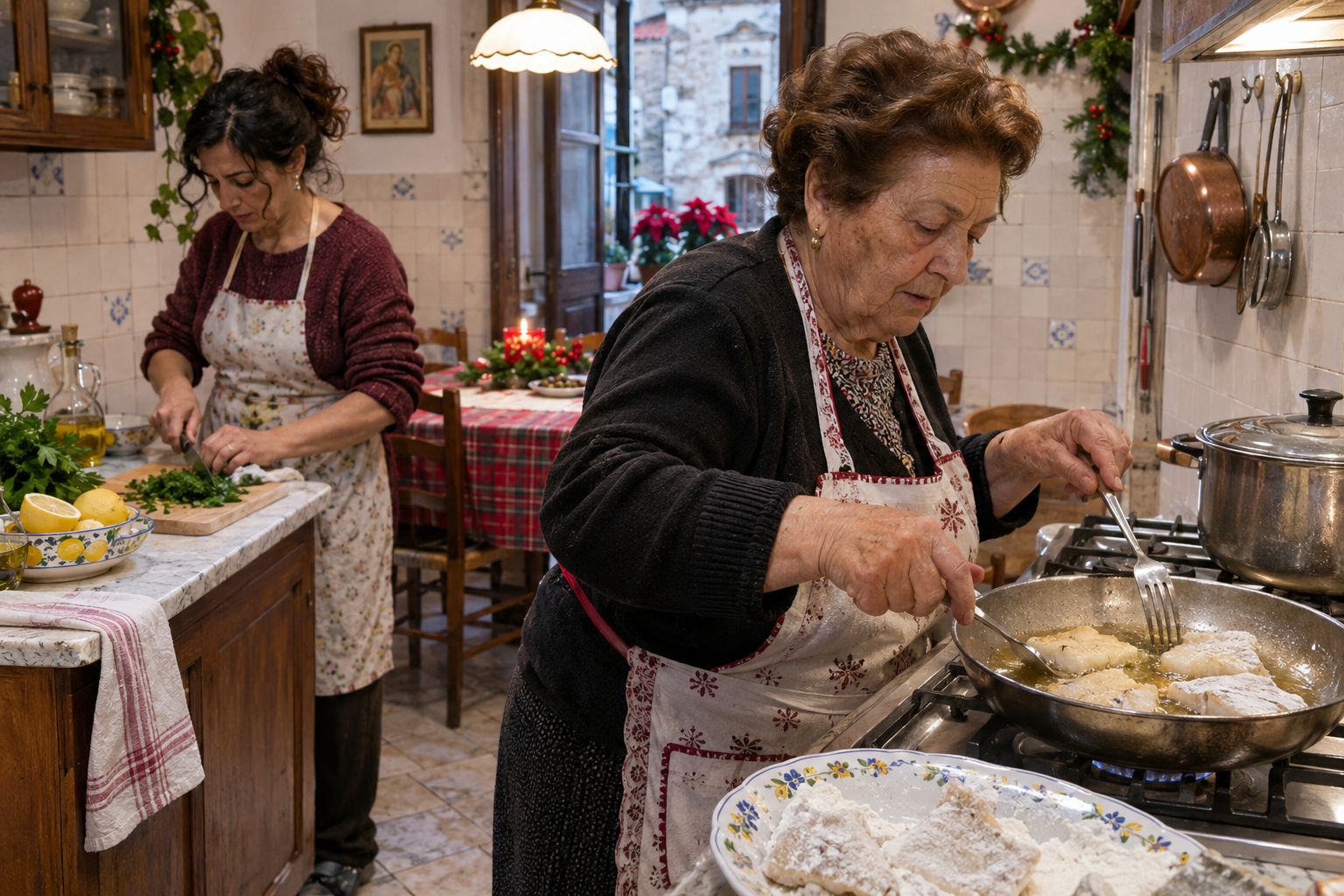
The charming thing about the “seven” is that even among the people who celebrate the Feast of the Seven Fishes, nobody quite agrees on why it is seven, which is itself a sign of a tradition that was codified after the fact rather than handed down with a clear origin. Ask around Italian-American families and you will hear a whole menu of explanations, each offered with confidence, none of them definitive.
Some say the seven represents the seven sacraments of the Catholic Church. Others say it stands for the seven days of creation, or the seven hills of Rome, or the number of days it took for various biblical events, or any of several other religiously flavored rationales. The sheer number of competing explanations is the tell.
When a tradition has one real, remembered origin, people tend to agree on it. When a tradition has a dozen plausible-sounding explanations and no consensus, it usually means the number came first and the meanings were attached afterward, folk justifications for a figure that was really just a convenient, memorable choice.
To make it more wonderfully confusing, the number is not even fixed at seven among those who keep the tradition. Plenty of families do nine fishes, or eleven, or thirteen, each with its own claimed significance, and some simply make as many dishes as they can manage. The variability of the supposedly fixed number is the final proof that this was never a rigid ancient rule but a flexible, affectionate, invented framework, one that gave a beloved immigrant tradition a shape and a story. The exact count matters far less than the gathering, the abundance, and the fish, which is probably exactly as it should be.
Not a Debunking, a Richer Story
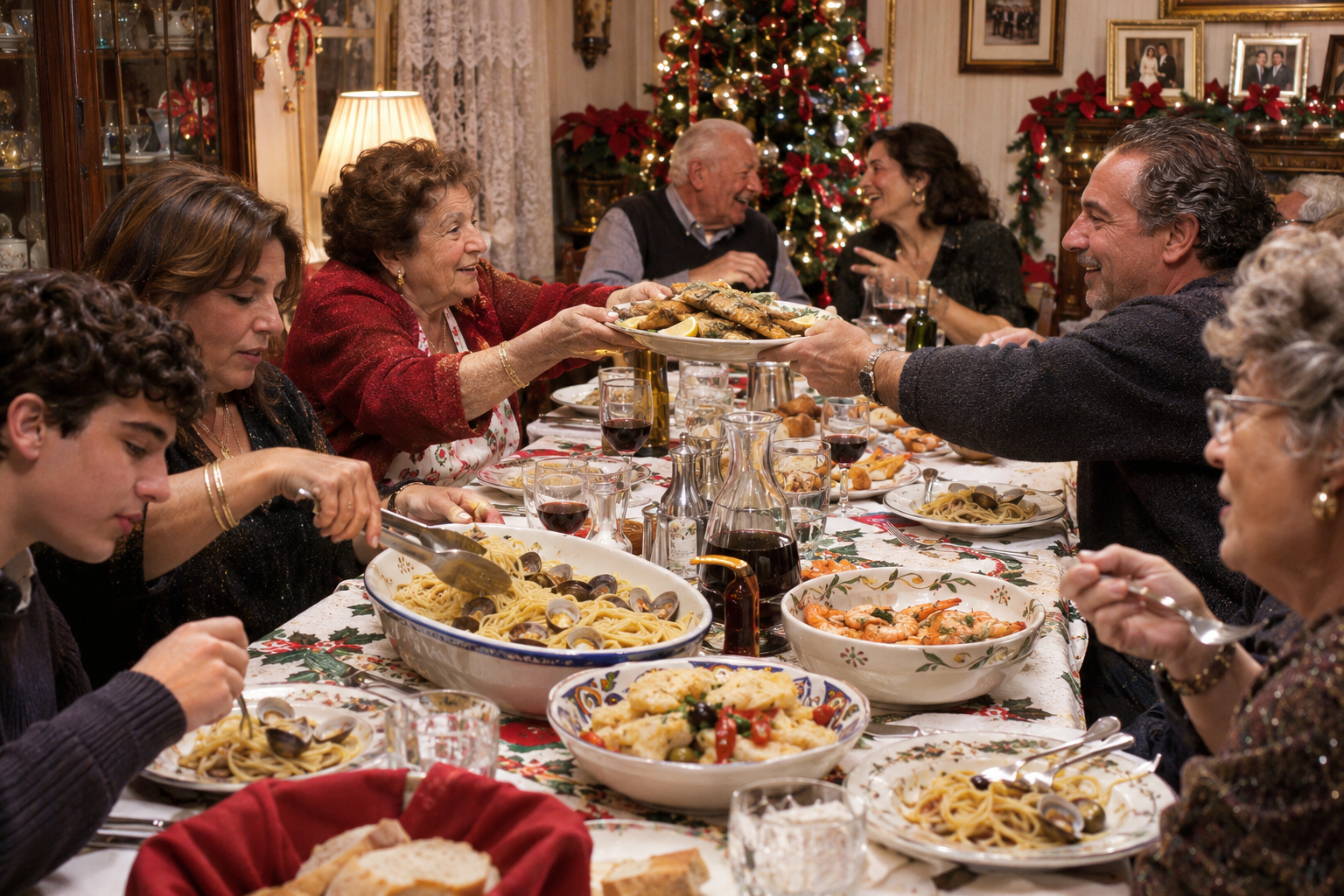
It would be easy to frame all this as a debunking, a gotcha aimed at Italian-Americans, but that is not the point at all, and it would miss what is genuinely lovely here. The Feast of the Seven Fishes is a completely real, deeply meaningful tradition. It is just an Italian-American tradition rather than an Italian one, and that distinction makes it more interesting, not less. It is a living example of how immigrant communities create something new and precious out of the threads they carry from home.
What happened is that real Italian immigrants took a real Italian custom and, in a new country, grew it into something with its own name, its own number, its own identity, and its own deep meaning for the community that made it. That is not a corruption of tradition. It is the birth of one. The Feast of the Seven Fishes belongs to Italian-America as fully and authentically as La Vigilia belongs to Italy, and it deserves to be understood on its own terms, as a genuine heritage tradition of a particular community, rather than measured against the old country and found somehow inauthentic.
This is also a useful thing to understand for anyone who moves between cultures, or who spends a first Christmas in Italy expecting to find the feast they grew up with. You will find fish on the Christmas Eve table, yes, and you will find the warm, abundant spirit behind it. But you will not find the Feast of the Seven Fishes by that name, and you should not be disappointed, because what you are seeing is the older, looser, regional root from which your American tradition grew. The two are relatives, parent and child, and recognizing the family resemblance across the difference is far richer than expecting them to be identical.
What Travels, and What Changes
The whole story is a small, perfect illustration of how traditions move across oceans and transform in the crossing. Something real and old, the Catholic meatless vigil and its fish dinner, left Italy in the suitcases and memories of immigrants. In America it met new conditions, the particular needs of a community holding onto its identity, and it changed, gaining a name, a number, and a fixedness it never had at home, becoming a new thing while keeping the soul of the old one.
This happens constantly with food and custom, and it is one of the quiet pleasures of paying attention to how people eat around the holidays. The dish or the ritual you think of as timeless and fixed very often turns out to have a specific, traceable, surprisingly recent history, shaped by migration, by memory, by the practical needs of real communities in real places. The Feast of the Seven Fishes is a particularly clear case because the gap between the American version and the Italian root is so visible, but the pattern is everywhere once you start looking.
For an American with Italian heritage, or anyone who loves the Christmas Eve seafood feast, none of this should dim the tradition one bit. If anything it should deepen it, because knowing that your grandparents or great-grandparents helped create this thing, that they took the fish dinner of the old country and made it into something with a name and a number and a meaning all its own, is a more moving story than simply inheriting an ancient rule. The Feast of the Seven Fishes is real, it is yours, and it is Italian-American, which is a heritage worth celebrating exactly as it is, seven fishes or nine or however many your family makes.

About the Author: Ruben, co-founder of Gamintraveler.com since 2014, is a seasoned traveler from Spain who has explored over 100 countries since 2009. Known for his extensive travel adventures across South America, Europe, the US, Australia, New Zealand, Asia, and Africa, Ruben combines his passion for adventurous yet sustainable living with his love for cycling, highlighted by his remarkable 5-month bicycle journey from Spain to Norway. He currently resides in Spain, where he continues sharing his travel experiences with his partner, Rachel, and their son, Han.