
Somewhere between a lavish dinner and nothing in the fridge sits one of the best cheap meals Italy ever invented, a dish of eggs poached in a bubbling red tomato sauce that costs almost nothing, dirties a single pan, and is on the table in twenty minutes. It is called uova in purgatorio, eggs in purgatory, and the name comes from the image of the white eggs peeking out of the fiery red sauce like souls amid the flames. It is humble, it is fast, it is gloriously good mopped up with bread, and it feeds a person for something like two euros a plate, which makes it exactly the kind of dish worth knowing when the week is long and the budget is tight.
Eggs in purgatory belongs to the tradition of Italian cucina povera, the cooking of poverty, where a few cheap pantry staples become a genuinely satisfying meal through nothing but technique and good sense. It asks only for eggs, a can of tomatoes, some garlic, oil, and a little heat, things almost always on hand, and it turns them into a warm, rich, comforting dinner in the time it takes to set the table. Here is what eggs in purgatory actually is, where the dramatic name comes from, how it differs from the dishes it resembles, why it costs so little, and how to make a pan of it tonight.
The Dish and Its Fiery Name
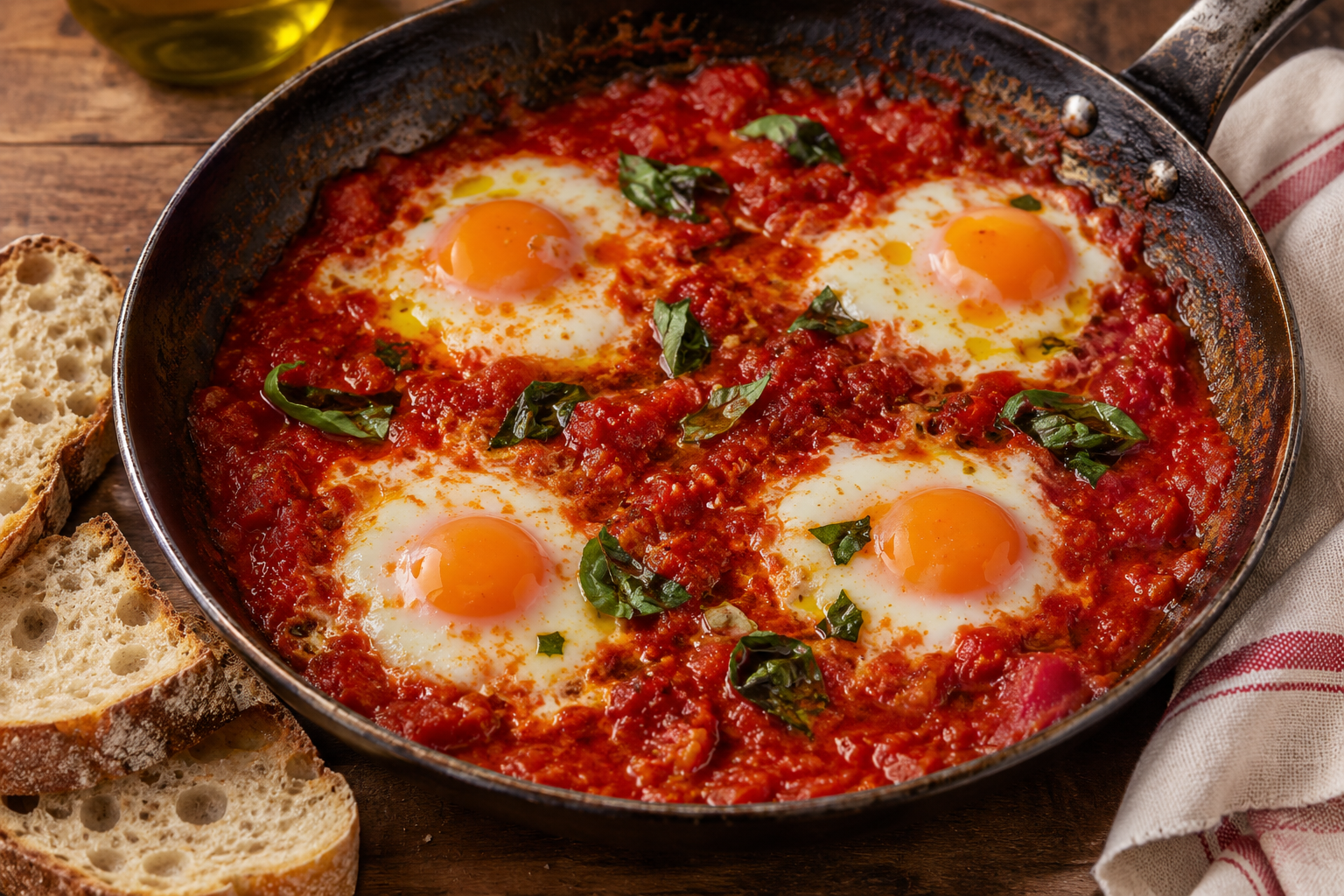
Eggs in purgatory is at its heart a very simple idea: a quick tomato sauce, made spicy and garlicky, into which eggs are cracked and poached directly, so they cook gently in the simmering sauce until the whites are set and the yolks are still soft and runny. It is cooked and served in one pan, the eggs nestled into the red sauce, and it is eaten with plenty of good bread for dipping into the yolk and scooping up the sauce. That is the whole dish, and its simplicity is its genius.
The name, in purgatorio, in purgatory, is the memorable part, and it comes from the vivid image the dish presents. The red tomato sauce, bubbling and spicy, stands in for the fires of purgatory, and the white of the eggs, peeking out of the sauce with the yolk like a soul amid the flames, completes the picture, so that the dish looks like the souls of purgatory surrounded by fire. It is a wonderfully Italian piece of imagery, turning a humble pan of eggs and tomato into a small theological tableau, and the spiciness of the sauce, the heat, reinforces the idea of the flames.
The dish is especially associated with Naples and southern Italy, the heartland of the quick tomato sauce and the cucina povera that produced so many brilliant cheap dishes, and it is the kind of thing an Italian home cook makes without a recipe, from instinct and whatever is in the cupboard. It has the feel of a dish invented and reinvented in countless kitchens over generations, a simple solution to the universal evening question of what to make from very little, and the dramatic name is the folk poetry that grew up around it. Eggs in a red sauce became souls in purgatory, which is a very Italian way to think about dinner.
Not Shakshuka, Not Piperade
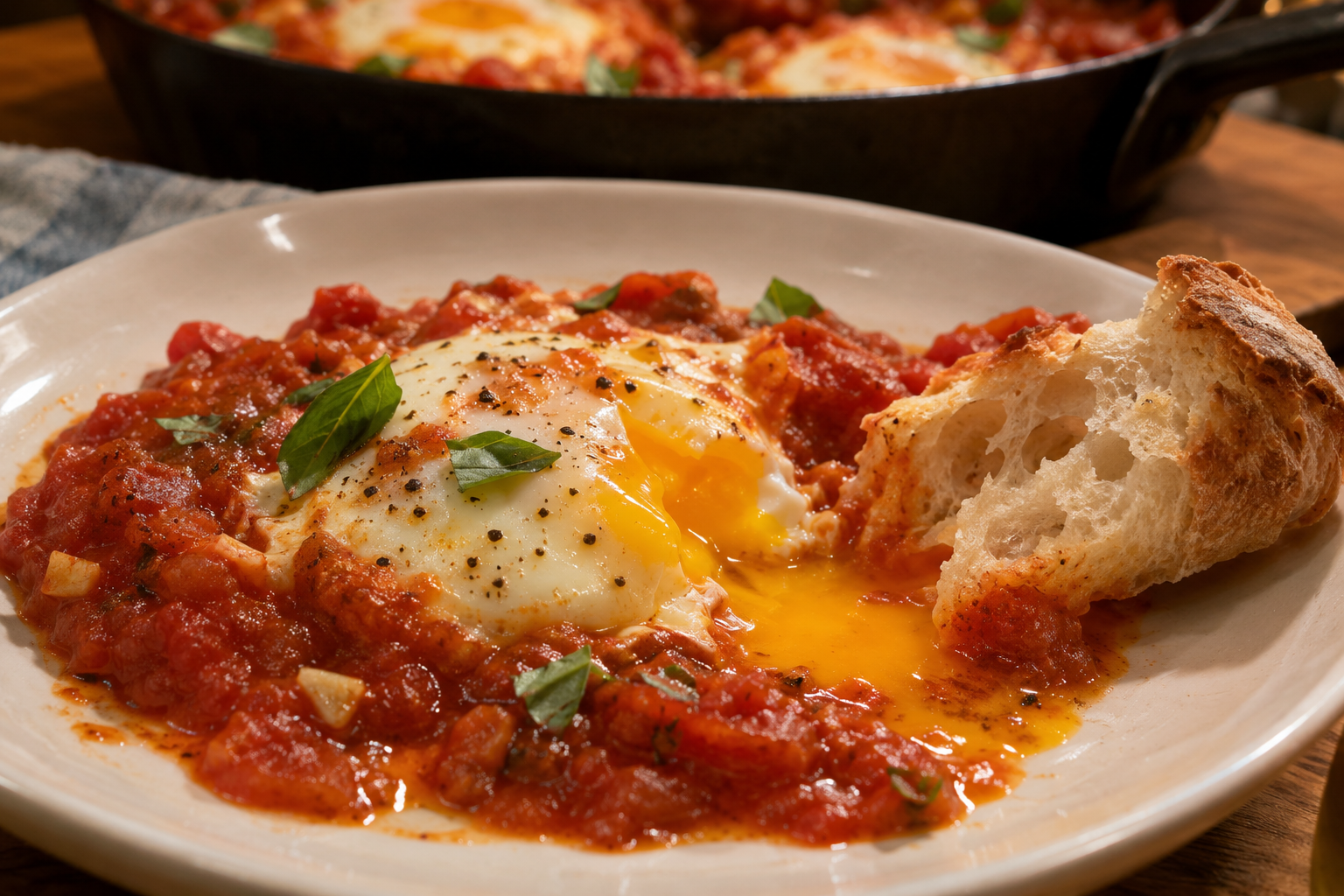
Anyone who has traveled or eaten widely will notice that eggs in purgatory resembles some other dishes, and it is worth drawing the distinctions, because while they are cousins they are not the same. The closest relative in most people’s minds is shakshuka, the North African and Middle Eastern dish of eggs poached in a sauce, and the two share the basic technique of eggs cooked in a simmering sauce. But shakshuka is built on a base of peppers and onions with spices like cumin and paprika, giving it a quite different, warmer, more complex flavor, where eggs in purgatory is simpler and purely Italian, just tomato, garlic, chili, and basil.
There is also piperade, the Basque dish we have written about separately, which again involves eggs and a tomato-and-pepper base but treats the eggs differently, often scrambled into the vegetables rather than poached whole on top, and carries the distinct flavor of Basque peppers. Eggs in purgatory is distinct from both in its Italian simplicity, the way it keeps the sauce to a straightforward spicy tomato and poaches the whole eggs in it, letting the yolks stay runny for the bread. It is the most pared-back of the family, which is part of its speed and cheapness.
The point of the comparison is not that one is better but that eggs in purgatory is its own specific thing, the Italian member of a wider family of eggs-poached-in-sauce dishes that appear all around the Mediterranean and beyond. Knowing the difference lets you make the genuine Italian version, a quick spicy tomato sauce and poached eggs, rather than drifting into a spiced shakshuka or a pepper-heavy piperade by accident. They are all wonderful, and they are all cheap one-pan egg dinners, but eggs in purgatory is the fastest and simplest, which is exactly why it costs so little and comes together so quickly.
Why It Costs So Little

The economics of eggs in purgatory are the quiet marvel of it, and they come straight from the cucina povera tradition it belongs to. Look at what goes into it: a few eggs, a can of tomatoes, some garlic, olive oil, a pinch of chili, a little basil, and bread to serve, and every one of those is among the cheapest things in any kitchen. Eggs are one of the most economical sources of protein there is, canned tomatoes cost very little, and garlic, oil, and chili are pantry basics, so the total cost of a plate comes in at around two euros or less, often considerably less.
This is not cheapness at the expense of satisfaction, which is the important thing, because the dish eats like a proper, warming, satisfying meal rather than a sad economy measure. The runny yolks and the rich spicy tomato sauce, soaked up with good bread, make a dinner that is genuinely delicious and filling, the kind of thing you would happily eat by choice rather than only by necessity. That combination of near-zero cost and real satisfaction is the hallmark of the best peasant cooking, and eggs in purgatory is a perfect small example of it.
It is also fast, which adds to the value, because a dish that costs two euros and takes twenty minutes in one pan is about as efficient as dinner gets on every axis that matters to a busy or budget-conscious household. There is no long shopping list, no expensive ingredient, no lengthy cooking, and no pile of dishes, just a single pan, a handful of staples, and twenty minutes to a hot meal. For anyone watching their spending, cooking for one or two on a tired evening, or simply wanting a reliable cheap dinner in the repertoire, eggs in purgatory earns its place many times over. It is the dish to make when the fridge is nearly empty and the wallet is too.
A Dinner at Any Hour
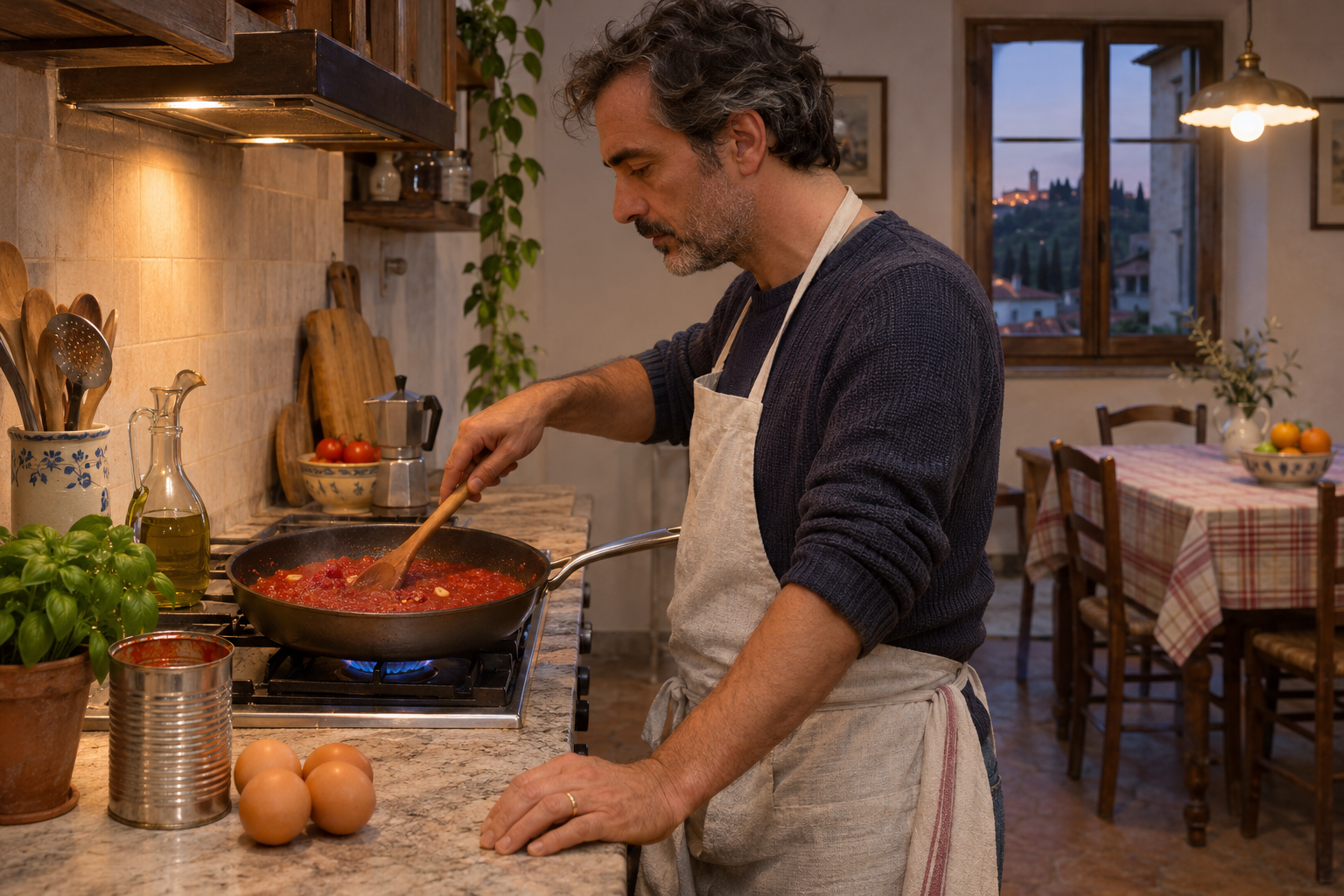
Part of what makes eggs in purgatory so useful to know is that it refuses to stay in the breakfast box where Americans tend to file anything made with eggs. In Italy it is eaten as a light supper as readily as a weekend brunch, a quick lunch, or a late plate after a long day, because a pan of eggs in a spicy tomato sauce with bread is simply a meal, not a time of day. The flexibility is the point, and it is why the dish earns a permanent place in a cook’s repertoire rather than an occasional outing.
Think of it as the thing to reach for when the question is what to make and the answer seems to be nothing. A near-empty fridge almost always still holds eggs and a can of tomatoes, and those two things plus a clove of garlic become a genuine dinner in twenty minutes, which is exactly the situation most home cooks face more often than they would like. Having a dish like this in your back pocket, cheap, fast, and built from what is always there, quietly removes a small recurring stress from the week.
For anyone cooking for one or two, which describes a great many expats and retirees abroad, eggs in purgatory scales down beautifully, needing no special shopping and no leftovers management. It is the sort of dish that makes cooking for yourself feel worth the small effort, a warm and proper plate rather than a sad solo snack, which is no small thing when the cooking is a daily fact of life.
Variations Worth Knowing

Once you have the basic method, the dish opens up into a family of easy variations that keep it from ever getting dull. The simplest is the heat, which you dial up or down with the chili to taste, from a gentle warmth to a proper southern-Italian kick, so the same dish can be mild comfort one night and a fiery pick-me-up the next. The sauce itself welcomes small additions too, a handful of greens such as spinach or chard wilted into the tomato before the eggs go in, or a few olives or capers for a saltier, more robust version.
Cheese is a natural partner and appears in many kitchens, a little grated parmesan or pecorino scattered over at the end, or torn mozzarella or ricotta dolloped into the sauce so it melts around the eggs for a richer, more substantial plate. A scattering of fresh basil or parsley at the finish brightens everything, and a drizzle of good olive oil over the top before serving is never wrong.
The bread deserves a thought as well, because it is not a side but part of the dish, the tool you eat it with. Toasted or grilled, rubbed with a cut clove of garlic, or simply fresh and crusty, the bread turns the runny yolk and spicy sauce into mouthful after mouthful, and getting good bread is the easiest upgrade there is. Treat the recipe below as a starting point and make it the way you like it, which is exactly how Italian home cooks have always treated it.
Make It: Uova in Purgatorio

This serves two from one pan in about twenty minutes. The keys are a quick garlicky, spicy tomato sauce and gentle poaching so the yolks stay runny. Serve immediately with plenty of crusty bread for mopping.
Ingredients
- 2 tablespoons olive oil
- 2 cloves garlic, sliced or chopped
- half a teaspoon chili flakes, or to taste
- 400g can of chopped or whole peeled tomatoes
- salt and pepper
- 4 eggs
- a handful of fresh basil, torn
- grated parmesan or pecorino (optional)
- crusty bread, to serve
Instructions
Heat the olive oil in a wide frying pan or skillet over medium heat and add the garlic and chili flakes, cooking gently for a minute or so until fragrant but not browned, so the garlic flavors the oil without burning.
Add the tomatoes, crushing whole ones with a spoon, season with salt and pepper, and let the sauce simmer for about eight to ten minutes, stirring now and then, until it has thickened slightly and lost its raw taste. This quick sauce is the bubbling purgatory the eggs will cook in, so let it reduce to a good spoonable consistency.
Make small wells in the sauce with the back of a spoon, and crack an egg into each well, spacing them around the pan. Season the eggs lightly with salt and pepper.
Cover the pan with a lid and let the eggs poach gently in the simmering sauce over low to medium heat, which steams the tops while the sauce cooks the bottoms, for about five to eight minutes, until the whites are set but the yolks are still soft and runny. Keep an eye on them, because the yolks can firm up quickly, and the runny yolk is the whole point.
As soon as the whites are set and the yolks are still soft, take the pan off the heat. Scatter over the torn basil and a little grated cheese if using, and bring the whole pan to the table. Serve at once, spooning eggs and sauce onto plates or letting everyone dip straight into the pan, with plenty of crusty bread to mop up the yolk and the spicy tomato sauce. That is dinner, for about two euros, in twenty minutes, from one pan.

About the Author: Ruben, co-founder of Gamintraveler.com since 2014, is a seasoned traveler from Spain who has explored over 100 countries since 2009. Known for his extensive travel adventures across South America, Europe, the US, Australia, New Zealand, Asia, and Africa, Ruben combines his passion for adventurous yet sustainable living with his love for cycling, highlighted by his remarkable 5-month bicycle journey from Spain to Norway. He currently resides in Spain, where he continues sharing his travel experiences with his partner, Rachel, and their son, Han.